 airbrakecompressor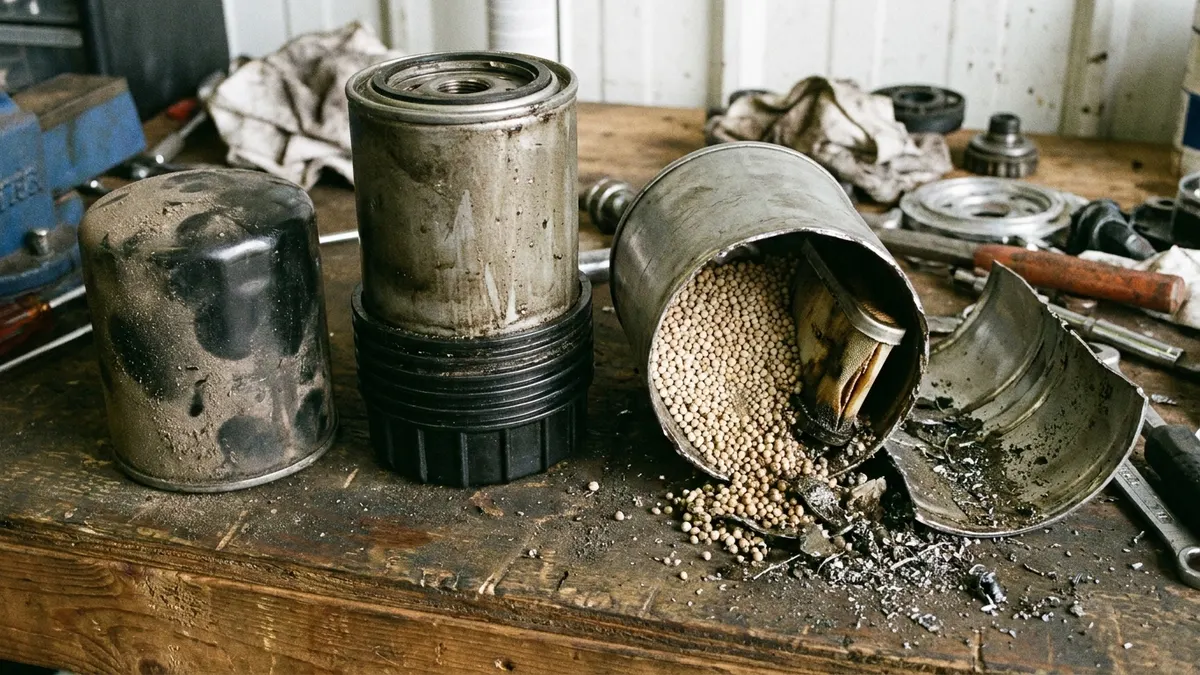
A coalescing filter air dryer uses a cartridge with an extra stage of fine fibre media ahead of the desiccant bed. That media catches the oil aerosol coming off the compressor and coalesces it — merges the microscopic droplets into drops heavy enough to fall into the dryer sump, where the purge valve blows them out to atmosphere at governor cut-out. A plain desiccant cartridge does none of that: it adsorbs water vapour and lets oil mist pass straight through, where it slowly glazes the beads and carries on downstream into the tanks and valves.
So the short answer: a coalescing cartridge protects the desiccant and everything past it from oil. It does not dry the air any better than a good plain cartridge on clean air — it keeps the air clean enough for the desiccant to keep doing its job.
Where the oil comes from
Every reciprocating air brake compressor passes some oil. It is pressure-fed from the engine oil gallery, its pistons run rings in a bore, and a small amount of blow-by inevitably carries into the discharge air as a hot mist. That is normal and a healthy compressor's contribution is small enough for the dryer sump and purge to deal with.
The trouble starts when the volume goes up. High duty cycle is the usual culprit: a compressor that spends more than roughly a quarter of its running time loaded gets hot, and hot compressors pass more oil. Add a restricted intake, a discharge line packed with carbon, high crankcase pressure from engine blow-by, or a governor that never lets the compressor unload, and the dryer sees far more oil than it was designed for. Understanding why a compressor pumps oil matters more here than the cartridge choice, because the cartridge is only ever the last line of defence.
Why oil ruins a desiccant cartridge
Desiccant works on surface area. The beads are riddled with pores that hold water molecules out of the airstream until the purge cycle at governor cut-out — typically somewhere in the 120 to 135 psi band — reverses the flow and drives that moisture back out. Oil films over the bead surface and plugs those pores. Once that happens the cartridge stops adsorbing, and you get water carryover into a system that still looks healthy on the dash: fully charged around 120 psi, cut-in around 100 to 110 psi, no warnings.
What you see instead are secondary faults. Water and oil emulsion in the tank drains. Relay and levelling valves that stick or respond late. ABS and EBS solenoids with tight clearances that fault intermittently. Nylon tubing and elastomer seals that swell where oil sits in them. In winter, moisture that should have been purged freezes in lines and valve bodies. A good overview of how the air dryer fits into the charging system makes it obvious why one fouled cartridge can throw faults halfway down the trailer.
Coalescing versus plain desiccant cartridge
| Feature | Standard desiccant cartridge | Coalescing cartridge |
|---|---|---|
| Primary job | Adsorb water vapour | Adsorb water vapour plus separate oil aerosol |
| Oil aerosol | Passes through; slowly glazes the beads | Coalesced into droplets, collected in the sump, expelled at purge |
| Fine solids and carbon | Largely uncontrolled | Captured by the fibre stage |
| Water removal capacity | Full desiccant volume for the housing | Same or slightly less desiccant in the same package size |
| Airflow restriction | Low | Slightly higher when new, much higher once loaded with oil |
| Best suited to | Clean-running engines, moderate duty cycle | High duty cycle, known oil carryover, valve-heavy systems |
| When overloaded | Silent failure: water carryover | Visible failure: slow air build, long charge times |
| Relative cost | Baseline | Higher per cartridge, often lower total system cost |
Most OE suppliers — Bendix, ZF (Wabco), Knorr-Bremse, Haldex — offer a coalescing version of their standard cartridge for the same housing. They are not universally interchangeable, though. Some housings are built with the sump volume and purge arrangement to suit a coalescing element, and some are not, so match by the dryer's own part number rather than by thread size alone. If you are comparing options across the different cartridge types before ordering, that housing compatibility is the first thing to settle.
When a coalescing cartridge is the right call
- You find oily residue at the purge exhaust or an oil film in the wet tank drain, and the compressor has been checked out as serviceable.
- Vocational or stop-start work — refuse, mixer, transit bus, anything with air doors, kneeling or heavy air suspension use — where duty cycle is inherently high.
- The vehicle carries EBS, full ABS, air levelling and multiple relay valves, where contamination costs far more than a cartridge.
- The engine has known blow-by and is not due for overhaul yet, and you need to protect the brake system in the meantime.
- Fleet history shows repeat valve failures or repeat freeze-ups traced to contamination rather than to a single component.
When it is the wrong call
A coalescing cartridge filters oil. It does not stop a compressor from making it. Fitting one to hide a genuine oil-pumping fault buys weeks, not years, and the plugged element eventually chokes your air build.
Before you upgrade the cartridge, work through the actual causes. Check compressor duty cycle over a representative shift and hunt down leaks if it is running constantly. Inspect the intake path and filter for restriction. Pull the discharge line and look for carbon build-up, and confirm it is short, downward sloping and free of traps so the air cools before the dryer. Measure crankcase pressure and confirm the oil return path is clear. Verify the governor and unloader are cycling properly, because a compressor that never unloads runs hot and passes oil no matter what cartridge you fit.
Reading the symptoms
| What you see | Usual meaning | First move |
|---|---|---|
| Black oily spray under the purge exhaust | Oil carryover, or a saturated cartridge dumping its load | Drain tanks, check duty cycle and discharge line before replacing anything |
| Water in tanks with a recently fitted cartridge | Desiccant already oil-fouled, or air entering the dryer too hot | Check discharge line length, routing and carbon build-up |
| Slow build after a cartridge change | Coalescing element restricted, or wrong cartridge for the housing | Confirm part number and inspect the element for oil loading |
| Sticking levelling or relay valves, intermittent ABS faults | Oil and moisture reaching downstream valves | Decontaminate the system, then fit coalescing once the source is fixed |
| Winter freeze-ups in lines and valves | Moisture getting past the dryer | Test the purge valve and sump heater as well as the cartridge |
Fitting and service life
Follow the OEM interval for the vehicle rather than a rule of thumb — it varies widely by application and by whether the dryer sees a coalescing or plain element. Shorten it if the vehicle works a high duty cycle or has a history of oil carryover. On fitting, lubricate the seal lightly, tighten by hand and then the specified additional turns rather than by feel, and inspect the purge valve, the sump heater circuit and the outlet check valve while the dryer is apart. A cartridge is cheap; a purge valve that no longer seats will ruin the new one. Genuine air dryer valves and cartridges for commercial vehicles matched to the original housing are worth the small premium here, because a mismatched element with the wrong media area or seal profile simply fails early.
One last note: if the system has been running contaminated air for a long time, replacing the cartridge alone will not clean it up. Oil already sitting in the tanks, lines and valve bodies will find its way back to the new element. Drain and decontaminate the wet and dry tanks, blow out the lines, and only then fit the new coalescing cartridge so it starts its life doing the job it was designed for.
Need the part, not just the answer?
OE-grade air brake compressors and repair kits, manufactured and tested to commercial-vehicle standards.
Shop VADEN partsPublished by VADEN Original. Product links point to the manufacturer’s official catalogue. Specifications are general — always confirm figures against your vehicle’s service manual.