 airbrakecompressor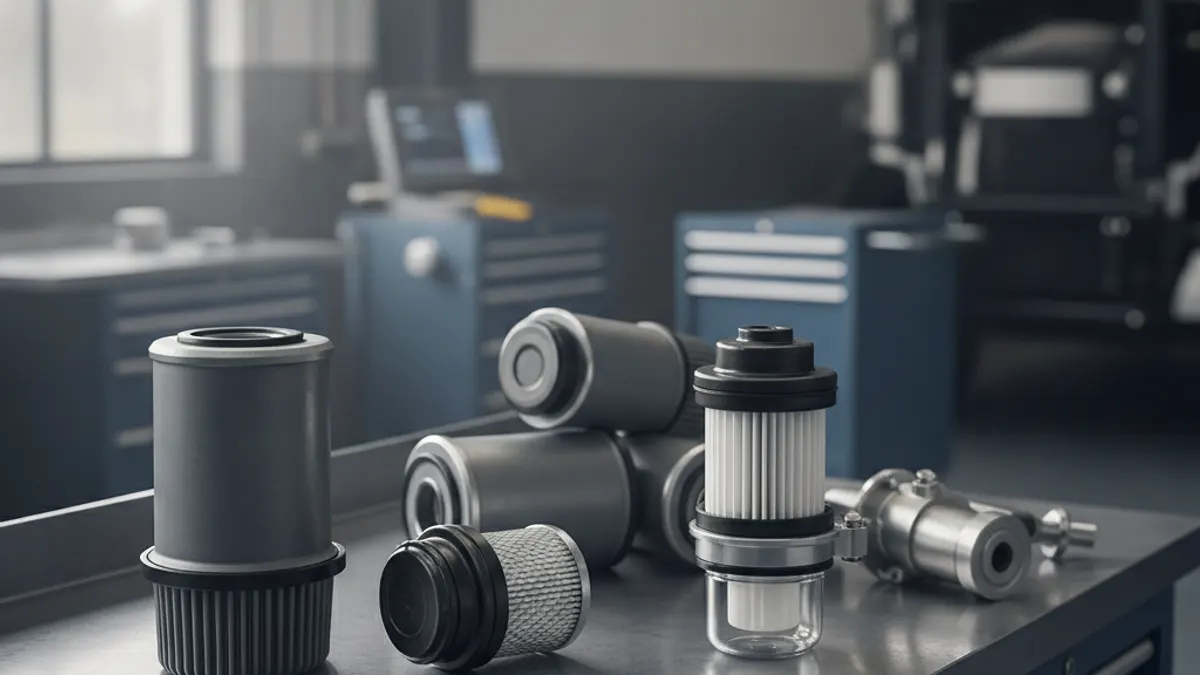
Truck air dryer cartridges come in two functional families. A standard desiccant cartridge holds a bed of desiccant beads that adsorb water vapour out of the compressed air and release it during the purge cycle. An oil-coalescing cartridge does the same job but adds a coalescing filter stage ahead of the desiccant bed to catch oil aerosol and fine soot before they can foul the beads. Fit the standard type on light-duty, clean systems serviced on the OEM interval; fit oil-coalescing where the compressor runs a high duty cycle, the engine is high-mileage, or you have already found oil downstream in the reservoirs and valves.
What the desiccant actually does
The compressor delivers hot, wet, oil-misted air into the pneumatic brake system. The dryer's job is to drop that air's temperature, knock out bulk liquid, and strip the remaining water vapour so the reservoirs and valves stay dry. The desiccant bed - a granular molecular-sieve or silica-type media - adsorbs water vapour onto the bead surface under pressure.
When the governor reaches cut-out, typically somewhere around 120-135 psi on a heavy commercial vehicle, the compressor unloads and the dryer purges. A reverse flow of dry air from the purge volume sweeps back through the bed, releases the trapped moisture, and blows it out of the purge valve along with collected oil and sludge. That is the sharp exhaust you hear at the end of every charge cycle. The compressor loads again at cut-in, roughly 100-110 psi. Exact settings vary by manufacturer and application, so work to the vehicle maker's current service data rather than a generic figure.
The weakness of that design is oil. Desiccant beads regenerate from water, not from oil. Once oil films the beads, that surface area is permanently lost and drying capacity falls off long before the media is physically worn out. That is the entire reason the oil-coalescing type exists.
Cartridge types compared
| Cartridge type | Removes | Best suited to | Typical service life |
|---|---|---|---|
| Standard desiccant | Water vapour; bulk liquid and some oil expelled at the purge valve | Light and medium duty, low duty-cycle compressors, clean engines | Shortest - usually the annual or standard mileage interval |
| Oil-coalescing | Water vapour plus oil aerosol and fine particulate | Line-haul, vocational, high duty cycle, high-mileage engines, air suspension and EBS systems | Longer in dirty service; often rated for an extended interval |
| Oil-coalescing with integral check valve | As above, with the check function built into the cartridge | Dryer bodies designed for a serviceable check valve in the cartridge | As oil-coalescing; check valve renewed at every change |
| Twin-tower / regenerative element | Water vapour continuously - one tower dries while the other regenerates | Buses, coaches and high-air-consumption chassis with air processing units | Per OEM schedule; elements changed as a pair |
Housing styles: spin-on, canister and integrated
Media type is only half the selection. The physical interface has to match the dryer body:
- Spin-on cartridge. The most common heavy-truck design. It threads onto the dryer base like an oil filter, sealing on a flat gasket or O-ring. Thread size and gasket diameter vary between manufacturers - they look interchangeable and are not.
- Cartridge-in-canister. The desiccant element sits inside a bolted or band-clamped housing. You replace the element and its seals rather than the whole can. Common on older dryer designs.
- Integrated air processing unit. On modern chassis the dryer is combined with the multi-circuit protection valve, pressure regulation and sometimes an ECU into a single air processing unit assembly. The cartridge still spins off the front, but the dryer body itself is application-specific.
- Heated versus unheated bases. The heater lives in the dryer base, not the cartridge. If you operate in freezing conditions, confirm the base heater works when you change the cartridge, because a frozen purge valve will destroy the new element quickly.
How to choose the right cartridge
- Start from the dryer, not the truck. Read the dryer body casting and label, note the manufacturer and model, then cross-reference. Two identical-looking trucks in the same fleet can carry different dryers.
- Match the interface. Thread pitch, seal diameter, and whether the cartridge carries an integral check valve. A cartridge that threads on but seals wrong will leak at the base and bleed air continuously.
- Assess the duty cycle. Air suspension, dump bodies, lift gates and city stop-start work all keep the compressor loaded far longer than steady highway running - that is oil-coalescing territory.
- Look at the evidence. Drain the wet tank. Oil sludge, black emulsion or standing water means the current setup is not coping; work through compressor oil pass-through diagnosis before you spend money on cartridges.
- Consider what is downstream. ABS and EBS modulators, air suspension levelling valves and disc brake actuators are far less tolerant of oil than older drum-and-relay-valve systems.
Replacement intervals
There is no single universal figure. Use the ranges below for planning and defer to the vehicle manufacturer's current service literature:
| Service condition | Standard desiccant | Oil-coalescing |
|---|---|---|
| Light duty, low annual mileage | Annually, or at the OEM mileage interval | Annually to two years, per OEM |
| Line-haul, steady duty | At or before the OEM mileage interval | Extended interval per the manufacturer's rating |
| Vocational, stop-start, air suspension | Shorten the interval - the compressor runs far more | Standard interval, monitored by reservoir drain condition |
| Known oil carry-over or after a compressor failure | Not recommended - move to coalescing | Immediately after the system has been decontaminated |
A cartridge change is a maintenance item, not a repair. If the dryer spits oil, purges constantly, or the reservoirs fill with water within a week of a fresh cartridge, the fault is upstream - compressor, unloader or governor - and the new cartridge will be ruined before the next inspection.
Cross-referencing and part identification
Cartridge cross-reference rests on three data points: the dryer manufacturer and model, the OE cartridge number stamped on the old part, and the thread and seal specification. Dryer makers each use their own numbering, and the same chassis builder may fit different dryers by market or model year. Record the number on the old cartridge before it goes in the bin, and note whether it carried an integral check valve. Where a supplier lists both a standard and a coalescing option under one reference, they are usually the same interface with different media, so upgrading is straightforward - provided the housing has clearance for the taller can, which some installations do not.
Installation points that decide cartridge life
- Bleed the system down fully and verify zero pressure at the dryer before unthreading anything.
- Clean the mounting face. A ridge of old gasket material is the most common cause of a base leak.
- Lightly lubricate the new seal with clean grease or the lubricant supplied. Never fit a dry O-ring.
- Hand-tighten until the seal contacts, then turn the additional fraction of a turn specified on the cartridge label. Over-torque distorts the seal and cracks housings.
- Charge the system back to a fully charged reading of about 120 psi, confirm the dryer purges at governor cut-out, then soap-test the base and purge valve.
- Check the low-air warning clears normally - buzzer and lamp should go out as pressure rises past roughly 60 psi.
- Drain the reservoirs a week later. Clean, dry air means the choice was right. For the full procedure see the cartridge replacement walkthrough, and for how the unit fits the wider circuit, the truck air dryer overview.
Match the media type to the duty cycle and the interface to the dryer, and a cartridge becomes one of the cheapest pieces of protection on the vehicle - it keeps water and oil out of every valve, chamber and modulator behind it.
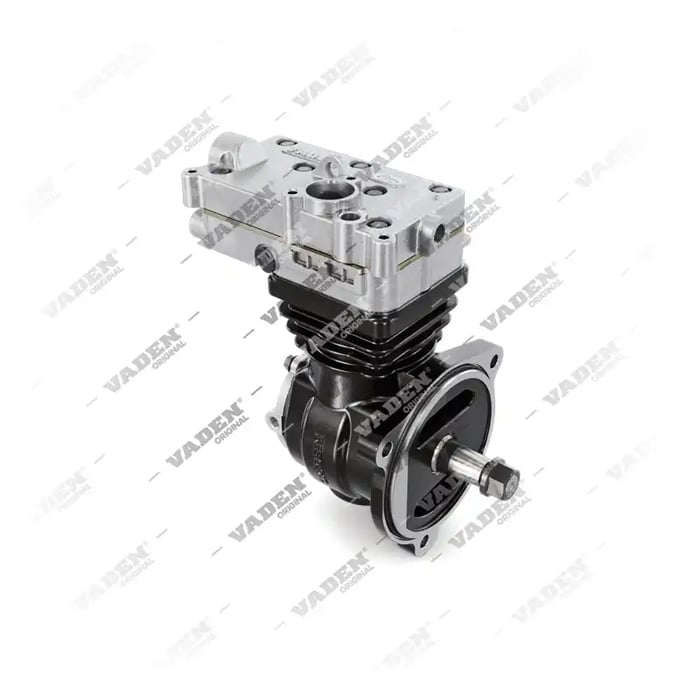
Need the part, not just the answer?
OE-grade air brake compressors and repair kits, manufactured and tested to commercial-vehicle standards.
Shop VADEN partsPublished by VADEN Original. Product links point to the manufacturer’s official catalogue. Specifications are general — always confirm figures against your vehicle’s service manual.