 airbrakecompressor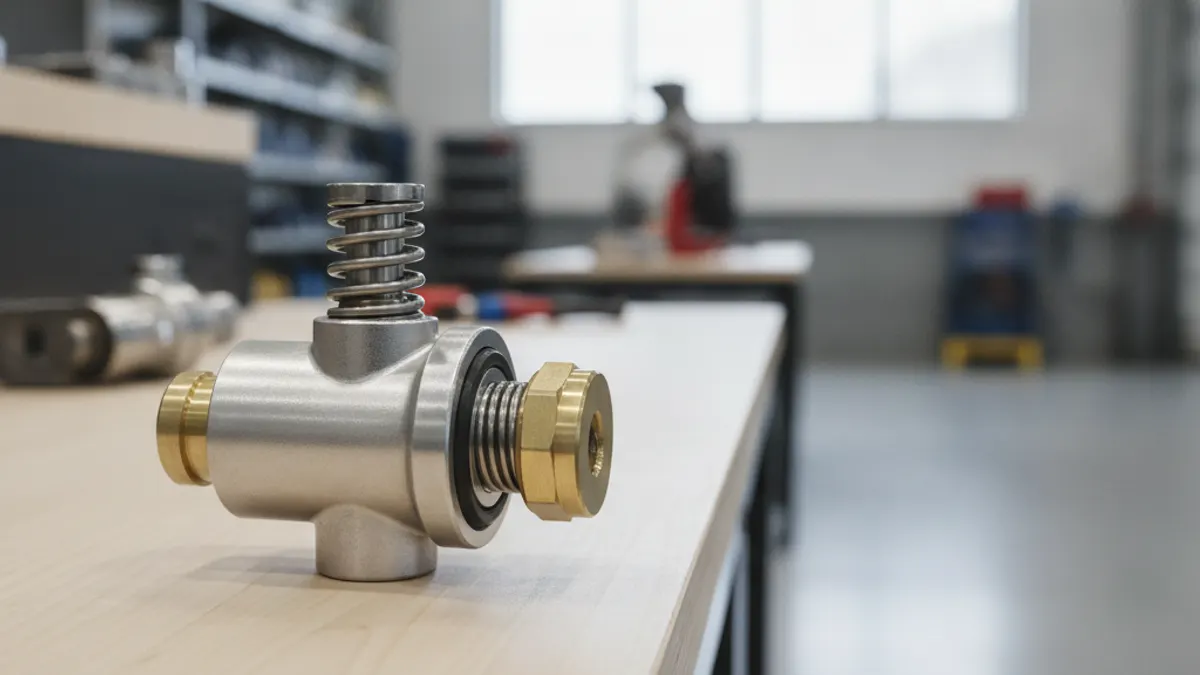
An air brake check valve is a one-way valve that lets compressed air pass in a single direction and blocks it from coming back. The system it serves is purely pneumatic — there is no hydraulic fluid anywhere in it — and the valve's job is isolation: air charges forward into a reservoir or circuit, and if pressure downstream of the valve is lost through a burst line, a cracked tank, or a failed fitting, the valve closes and protects everything upstream. That is why a tractor that loses a trailer line still has air in its own tanks to make a controlled stop.
Mechanically there is almost nothing to one: a disc, flapper, or spring-loaded poppet inside a threaded brass or steel body, with an arrow or the word IN cast into it to show flow direction. No adjustment, no electrical input. But a check valve stands between one healthy circuit and one failed circuit, so a valve that stops sealing quietly removes the redundancy the whole system is built around.
Where check valves sit in the air brake system
Most heavy trucks carry several, and their positions follow the airflow. Air leaves the compressor, passes through the air dryer, and enters the supply (wet) tank. From there it feeds the primary and secondary service reservoirs, and on a tractor-trailer combination onward to the trailer supply line.
| Location | What it protects against |
|---|---|
| Air dryer outlet / supply tank inlet | Tank air back-feeding through the dryer, so the purge cycle does not drain the reservoir |
| Supply tank to primary reservoir | A primary circuit rupture pulling down the supply tank |
| Supply tank to secondary reservoir | A secondary circuit rupture pulling down the supply tank |
| Trailer supply / gladhand branch | A disconnected or burst trailer line dumping tractor air |
| Auxiliary feeds (air suspension, seat, horn, PTO) | Non-brake accessories bleeding down brake reservoirs |
On many modern chassis the reservoir check function is built into a multi-circuit protection valve instead of existing as separate inline valves. The principle is identical — the protection valve simply packages several one-way, pressure-limited outlets into a single casting. Know which arrangement your chassis uses before you start diagnosing.
How the valve works
When upstream pressure exceeds downstream pressure by more than the seat's cracking pressure — usually only a few psi — the disc or poppet lifts and air passes. When flow stops and the two sides equalize, the spring or the disc's own weight closes it. If downstream pressure then falls, that differential pushes the seal harder onto its seat, so the failure the valve guards against is also the force that keeps it shut.
Symptoms of a failing check valve
Overnight pressure loss with no audible leak
A healthy system sits fully charged at roughly 120 psi, with governor cut-out typically somewhere in the 120 to 135 psi range and cut-in around 100 to 110 psi. Park a charged truck, shut it down, and both gauges should hold with only a small static drop. Gauges that have fallen well down by morning, with no hiss anywhere on the chassis, mean air is traveling backward through a check valve and out of the compressor inlet or the dryer purge. If the vehicle also loses pressure while you drive, work through the whole system rather than the valves alone.
Uneven tank gauges
Primary and secondary gauges should track closely on a charged system. If one circuit reads noticeably lower and keeps drifting down, suspect the check valve feeding it, then that reservoir and its lines. A stuck-closed or restricted valve produces the opposite complaint: the circuit is slow to charge or never charges, and the low-air warning — set around 60 psi on most vehicles — may stay on.
Excessive compressor cycling
Air that leaks backward is air the compressor has to make again. Repeated governor cut-in with the truck standing still drives up duty cycle, head temperature, and oil carryover. Chronic overwork shortens compressor life — the compressor is not defective, it is backfilling a leak.
Air escaping at the dryer or compressor after shutdown
A steady discharge from the dryer purge valve after shutdown, or air blowing back through the compressor inlet, is a strong check valve signature. Do not condemn the dryer cartridge before checking the valve.
Trailer air loss pulling the tractor down
Uncoupling a trailer should not cost the tractor its air. If disconnecting, or a trailer line failure, drags tractor pressure down, the branch check valve or the tractor protection valve is not doing its job. That is a safety defect, not an inconvenience.
Testing a check valve
- Chock the wheels and charge the system. Build to full pressure, let the governor cut out, then shut the engine off.
- Listen at the compressor and dryer. Air moving backward is usually audible at the compressor inlet or the dryer purge port. Air leaving either one with the engine off means a check valve is passing.
- Record each gauge, then wait. Note the primary and secondary readings and hold static for several minutes, first with the parking brakes released and then applied. One circuit dropping while its partner holds isolates the branch.
- Soap test the valve body. Spray soapy water on the valve, its threads, and both fittings. Bubbles mean a body or thread leak; no bubbles with continued pressure loss means the seat is passing internally.
- Bench check it. Off the truck you should be able to blow through the valve in the flow direction and not at all against it. Any reverse flow condemns it.
- Rule out the neighbors. A slow-bleeding circuit can also be a reservoir drain valve, a relay valve exhaust port, or a brake chamber diaphragm. Check the quick, cheap items before pulling plumbing apart.
Check valves are cheap and often buried behind other components, so replace rather than clean or rebuild. Rust flakes, oil varnish, and carbon from a compressor that has been passing oil are the usual reason a seat stops sealing, and a pitted seat will not recover. If the system has been oil-contaminated, replace the check valves along with the dryer cartridge, or the new cartridge inherits the same debris. Replacement VADEN Original air brake check valves are a small line item next to the labor of chasing the same leak twice.
Replacement notes
- Drain the system first. Fully exhaust every reservoir before loosening a fitting, chock the wheels, and block the vehicle. Never work under a truck held up only by air pressure.
- Note orientation before removal. Photograph or mark the flow arrow. A check valve fitted backward blocks charging completely and produces a very confusing no-build complaint.
- Use thread sealant sparingly. Sealant belongs on tapered pipe threads only, kept back from the first thread so nothing migrates into the seat. Never leave tape fragments in an air brake system.
- Match port size and body type. Inline, tank-mount, and integral dryer check valves are not interchangeable even when the threads happen to fit.
- Verify after assembly. Recharge, confirm normal governor cut-out, soap the new joints, then repeat the static leak-down test and finish with a full seven-step air brake check before the truck goes back to work.
Maintenance that keeps them alive
Check valves fail because of what passes through them, so two habits do most of the work: draining the tanks on schedule so water and emulsified oil are not sitting against the seats, and servicing the air dryer cartridge on interval. Fix a compressor that carries oil promptly: oil downstream shortens the life of every valve and diaphragm in the system.
Treat unexplained pressure loss as a fault to be found, not a quirk to live with: a check valve that no longer seals has removed a layer of redundancy the system was designed around. Cracking pressures, governor settings, and fitting torques vary by chassis, so confirm the figures against the vehicle manufacturer's current service manual.
Need the part, not just the answer?
OE-grade air brake compressors and repair kits, manufactured and tested to commercial-vehicle standards.
Shop VADEN partsPublished by VADEN Original. Product links point to the manufacturer’s official catalogue. Specifications are general — always confirm figures against your vehicle’s service manual.