 airbrakecompressor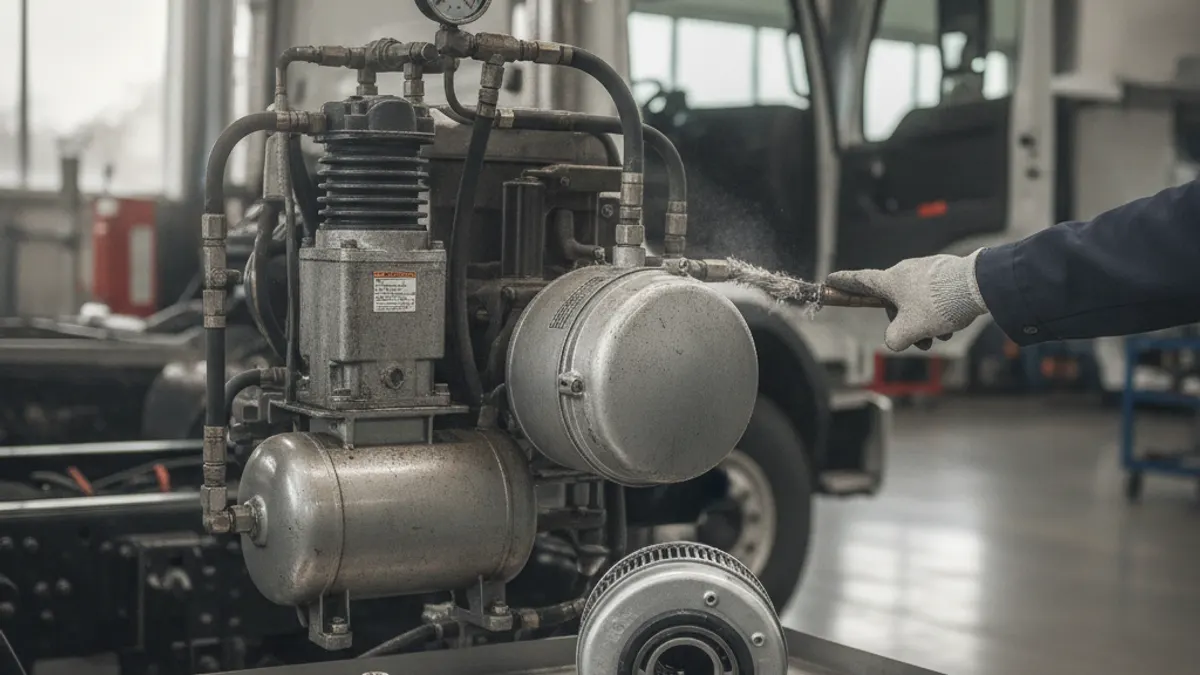
If a truck climbs to a certain pressure and then flatlines — say it reaches 90 or 100 psi and parks there — the system is either being told to stop pumping, losing air as fast as it makes it, or restricted somewhere between the compressor and the tanks. Four faults cover nearly every case: a governor cutting out low, leaks that match compressor output, a carboned discharge line or plugged air dryer, or a worn compressor that no longer has the volume to stay ahead of normal system losses. The pressure at which it plateaus, and whether the compressor is still working when it plateaus, tells you which one you are chasing.
First, define the symptom precisely
"Won't build past X psi" covers two very different failures, and mixing them up sends the diagnosis down the wrong road.
- It stops and holds steady. Pressure rises normally, reaches a ceiling, and stays flat. The compressor has been unloaded. That points at the governor or the unloader circuit.
- It stalls but never really settles. Pressure creeps, hangs, or drifts down when the engine drops to idle, and the compressor is clearly still working. That points at leaks, restriction, or a tired compressor.
Listen at the governor when the needle stops climbing. A distinct exhaust puff, and the compressor going quiet, means it commanded cut-out. No puff, with the compressor still loaded and working hard, means nobody told it to stop — it simply cannot get ahead of the system.
Common causes, in the order worth checking
Governor cut-out set low or failing
A governor that cuts out at 95 or 105 psi instead of the usual 120–135 psi range looks exactly like a truck that "won't build." The system is healthy; it is just being shut off early. Governors drift with age, and some have been adjusted by a previous hand. A plugged or kinked supply line to the governor, or moisture and corrosion inside it, produces the same result. Confirm cut-out and cut-in with an accurate test gauge on the wet tank before touching anything else — setting and testing is covered in the air brake governor guide. If it never cuts in at all and the compressor simply stays unloaded, you are looking at a governor stuck at cut-out instead.
Leaks that match compressor output
A compressor in good shape can mask a surprising amount of leakage, right up to the point where the leak rate equals its output. Then pressure plateaus. Common offenders: brake chamber diaphragms, gladhand seals, push-to-connect fittings, dash valve bodies, the trailer supply circuit, and an air dryer purge valve that will not seat. Trailer leaks are easy to overlook, because they only show up once the supply valve is pushed in.
Restricted discharge line or plugged air dryer
The discharge line runs hot and carries oil vapour. Over years it cokes up with carbon, sometimes down to a pinhole. A restricted line lets the compressor pump against itself instead of into the tank, and the ceiling drops as the restriction worsens. The same applies to a desiccant cartridge that is saturated and packed with oil, or a purge valve frozen shut in winter. If the discharge line is discoloured, hard, or the fittings are crusted, replace the line rather than trying to clean it — and inspect the air dryer at the same time.
Worn compressor
Worn rings, scored bores, or leaking discharge valves cost volume. The classic pattern is a truck that builds fine to 70 or 80 psi and then takes forever to reach cut-out, with build time getting worse month over month. Oil in the tanks or at the dryer purge, and a compressor running hotter than normal, back this up. The wider pattern is set out in failing air brake compressor symptoms.
Intake restriction
Most compressors draw through the engine air cleaner or a dedicated inline filter. A plugged filter, a collapsed intake hose, or a rag left in the intake starves the compressor. Cheap to check, and it happens more often than people admit.
A gauge that is lying
Dash gauges wander. Before condemning a compressor, tee an accurate mechanical gauge into the wet tank. It is not unusual to find the system building fine to 125 psi while the dash insists it stopped at 95.
Reading the plateau
| What you observe | Most likely cause | Next check |
|---|---|---|
| Steady plateau, governor puffs, compressor goes quiet | Governor cut-out set low or failing | Verify cut-out and cut-in with a test gauge |
| Plateau with the compressor still loaded and audible | Leakage equals output, or restriction | Static leak-down test, then the discharge line |
| Builds fast to roughly 80 psi, then crawls | Worn compressor or restricted discharge | Timed build test, inspect discharge line |
| Continuous hiss at the dryer | Purge valve not seating | Rebuild or replace the purge valve |
| Only fails in cold weather | Frozen moisture in dryer or lines | Drain tanks, check dryer heater circuit |
| Fails only with a trailer coupled | Trailer-side leak or gladhand seals | Isolate with the supply valve out, retest |
A diagnostic sequence that works
- Chock the wheels. Drain every reservoir and note how much water and oil comes out — that alone says a lot about dryer health.
- Tee an accurate test gauge into the wet tank so you are working from real numbers, not the dash.
- Run a timed build-up test. The commonly cited benchmark for a dual system is 85 to 100 psi in 45 seconds or less at roughly 600–900 rpm. Slower than that means low volume or restriction.
- Note the governor cut-out point. Expect roughly 120–135 psi, with cut-in typically 20–25 psi below that, generally in the 100–110 psi band.
- Shut the engine off, release the brakes, and watch the leak-down rate. Common limits are about 2 psi per minute for a single vehicle and 3 psi per minute for a combination with the brakes released, and roughly 3 and 4 psi per minute respectively with a full application held.
- If leak-down is out of spec, find the leak with soapy water before condemning any component. Work the trailer supply and dash valves in and out to expose circuit-specific leaks.
- If leak-down passes but build is slow, disconnect and inspect the discharge line and dryer inlet for carbon. Replace the line if the bore is reduced.
- Only after all of the above is it worth pulling the compressor.
Reference values
| Parameter | Typical range |
|---|---|
| Governor cut-out | 120–135 psi |
| Governor cut-in | 100–110 psi |
| Normal fully charged pressure | around 120 psi |
| Low-air warning activates | about 60 psi |
| Spring brakes begin to apply | roughly 20–45 psi |
| Build-up, 85 to 100 psi | 45 seconds or less at 600–900 rpm |
These are general service ranges for pneumatic air brake systems, not a substitute for the OEM figure. Always work to the vehicle manufacturer's current service data for the specific chassis.
Repair or replace
Governors, unloader kits, purge valves, and desiccant cartridges are routine wear items and worth replacing on their own. The compressor is a different decision. If the unit is passing oil, running hot, and failing a timed build test after the discharge line and dryer have been ruled out, a new or properly remanufactured compressor is the durable answer — patching one worn valve plate on a high-mileage unit rarely holds. Whenever a compressor comes off, replace the discharge line and service the dryer at the same time. Carbon left in that line will choke the new compressor's output within months.
Never road-test a truck that will not reach normal operating pressure. Below the low-air warning threshold you are one hard application away from the spring brakes setting themselves, and a system that cannot recover pressure has no reserve for a second stop.
If the timed build test condemns the unit, confirm the mounting, drive type and displacement before ordering, so the replacement air brake compressor goes on together with the new discharge line in a single visit.
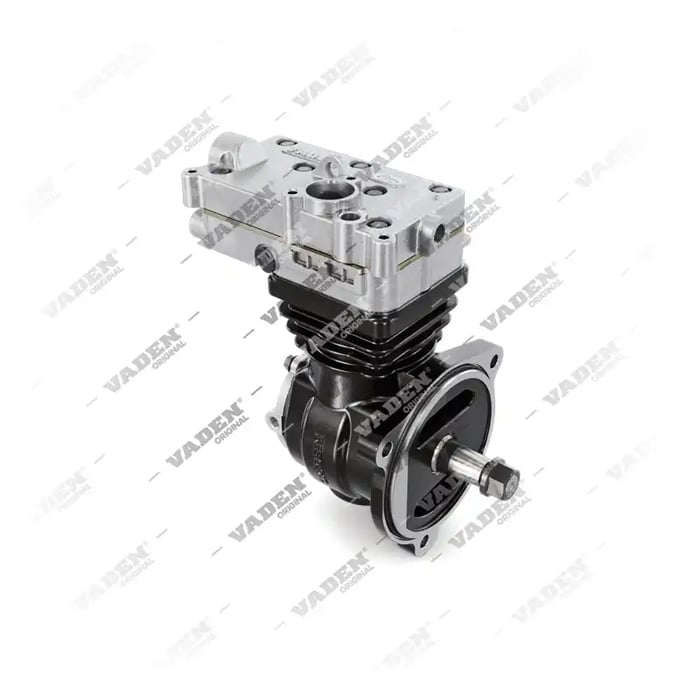
Need the part, not just the answer?
OE-grade air brake compressors and repair kits, manufactured and tested to commercial-vehicle standards.
Shop VADEN partsPublished by VADEN Original. Product links point to the manufacturer’s official catalogue. Specifications are general — always confirm figures against your vehicle’s service manual.