 airbrakecompressor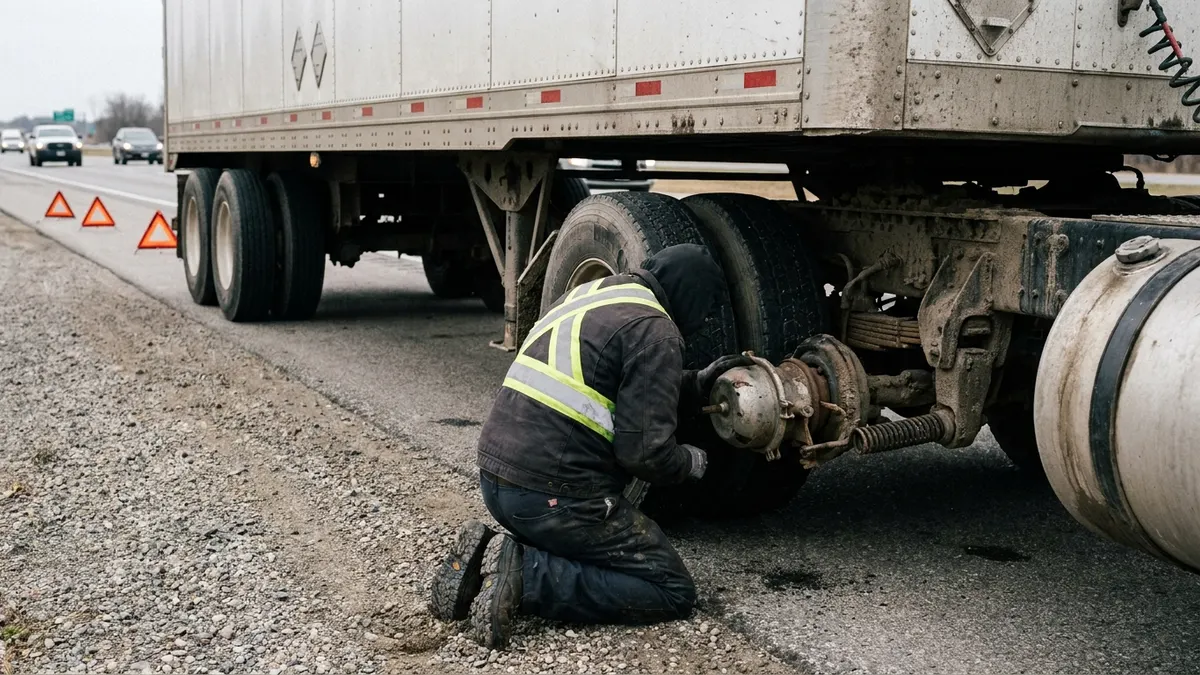
If a truck's air brakes apply on their own, the system is usually doing exactly what it was built to do: reservoir pressure has fallen far enough that the spring (parking) brakes take over. Spring brakes begin to drag on and then set fully as pressure bleeds down through roughly the 20-45 psi range, so any leak, stuck governor, or failed valve that empties the tanks will eventually park the vehicle for you. The second family of causes is different — a valve that will not exhaust, holding partial pressure at the service chambers, which the driver feels as grabbing, dragging, or brakes that never fully let go even with a full system.
First question: full application or a drag?
These are two separate faults and they lead to two different diagnostic paths. Sort the complaint before you touch a wrench.
Full, hard application that stops the truck. The dash valves have popped out, the tractor protection valve has closed, and the springs are set. This is an air supply problem. Read the gauges: if either service reservoir is below the 20-45 psi band, the springs did their job and the real fault is upstream — a burst line, an open drain cock, a ruptured diaphragm, a compressor that quit building, or a governor stuck in unload.
Partial application, drag, or grab while pressure stays normal. Both needles sit near a fully charged ~120 psi, the governor is cycling normally between roughly 100-110 psi cut-in and 120-135 psi cut-out, but one axle or one wheel end stays applied. That is a control valve or foundation problem, not an air supply problem.
Why the springs apply automatically
A heavy vehicle parking brake is held off by air. A large coil spring inside the parking chamber wants to apply the brake at all times; roughly 60-90 psi of air holds it caged during normal driving. Pull the yellow knob, break a supply line, or let a leak drain the tank, and the air behind that spring vents. The brake applies. There is no hydraulic fluid anywhere in this system — everything above is pneumatic, and pressure loss always fails toward "applied," never toward "released."
Dash control valves are built to pop out on their own in the same pressure window, which is why a slow leak overnight often leaves a trailer set in the morning. On a combination, a broken or disconnected trailer supply line triggers an emergency application at the trailer through the same mechanism.
Common causes, ranked by what you see
| What the driver reports | Most likely cause | First check |
|---|---|---|
| Brakes set hard, gauges low, buzzer sounded first | Air loss: leak, failed compressor, governor stuck unloaded | Build pressure, listen for the leak, confirm cut-out 120-135 psi |
| Brakes set hard, gauges low, no warning ever came on | Air loss plus a dead low-air warning switch or bulb | Bleed to about 60 psi and verify the light and buzzer |
| One axle drags, system pressure normal | Relay valve not exhausting, or contaminated delivery port | Cap the service line to that relay and watch for release |
| Steer axle brakes drag on release | Quick-release valve holding air at the chambers | Crack the chamber fitting; if it hisses, the valve is not venting |
| Brakes reapply when the parking brake is set | Failed anti-compounding valve | Set the yellow knob and press the treadle; chambers should not add air |
| Light pressure held at all chambers, pedal released | Foot (treadle) valve not returning, or a bound pedal linkage | Check pedal free travel and treadle exhaust |
| Comes and goes in cold weather | Moisture freezing in valves or lines; failed air dryer | Drain tanks, check dryer purge, thaw and retest |
| One wheel only, after a brake job | Over-adjusted slack, seized S-cam, weak return springs | Measure pushrod stroke and check cam rotation |
The anti-compounding trap
When the spring brakes are set and the driver also presses the pedal, the springs and the service diaphragm can push the same pushrod. That combined force is called compounding, and it can bend slack adjusters, split chambers, and leave a brake that will not release afterward. An anti-compounding valve exists to prevent it by balancing air on both sides. If that valve fails, a driver who rides the pedal while parked can end up with brakes locked on their own — and the damage often only shows up when the truck refuses to roll. Any time you find a truck with brakes applied for no obvious reason, look at the parking and emergency control group, including the dash valves and park release and emergency valves that manage spring brake supply.
Isolating the circuit
- Chock the wheels. Do not rely on air holding anything.
- Build the system and confirm the governor cuts out in the 120-135 psi window and cuts back in around 100-110 psi. A governor stuck in unload will never charge the tanks.
- Note where the drag is: one wheel, one axle, both tractor axles, or trailer only. That single observation eliminates most of the list.
- Work backward from the chamber. Crack the service line at the dragging chamber. If air escapes with the pedal released, the fault is upstream in the relay or quick-release valve. If nothing escapes, the fault is mechanical at the foundation brake.
- Swap or cap suspect valves one at a time. Replacing a relay and a quick-release together tells you nothing about which one failed.
- Drain every reservoir. Water and oil carried past a saturated air dryer cartridge will gum a valve spool and cause intermittent, no-fault-found complaints. If the tanks push out sludge, the dryer needs attention before the valve gets blamed twice.
If the drag returns after the truck sits overnight but clears once the system charges, you are chasing an overnight leak plus a slow-releasing valve. Both need fixing; the leak set the springs, and the sticky valve kept a chamber applied afterward. The same logic applies when a trailer sets itself — see the wider path in air brake system losing pressure and the mechanical side in dragging brakes that will not release.
Safety steps before the truck moves
A spring brake stores enough energy to kill. Never remove a clamp band, disturb a pushrod, or pull a chamber until the spring is caged with the release tool and the wheels are chocked. If the truck must be moved to a bay, cage the springs mechanically rather than jury-rigging air into a suspect circuit — forcing air past a failed valve to free the brakes can drop them again mid-move.
If the brakes applied themselves once and you cannot explain why, the truck is not roadworthy. An unexplained self-application usually means an unfound leak, and the next one may happen at highway speed with the trailer.
Finally, check the warning devices before releasing the vehicle. The low-air warning must activate around 60 psi, well above the 20-45 psi range where the springs set. A driver who gets that warning has time to stop on the shoulder; a driver whose buzzer failed gets an unannounced parking-brake application in traffic. Fixing the leak and leaving a dead warning switch is only half a repair. Details on the standard release-and-return checks are covered in spring brake will not release.
Need the part, not just the answer?
OE-grade air brake compressors and repair kits, manufactured and tested to commercial-vehicle standards.
Shop VADEN partsPublished by VADEN Original. Product links point to the manufacturer’s official catalogue. Specifications are general — always confirm figures against your vehicle’s service manual.