 airbrakecompressor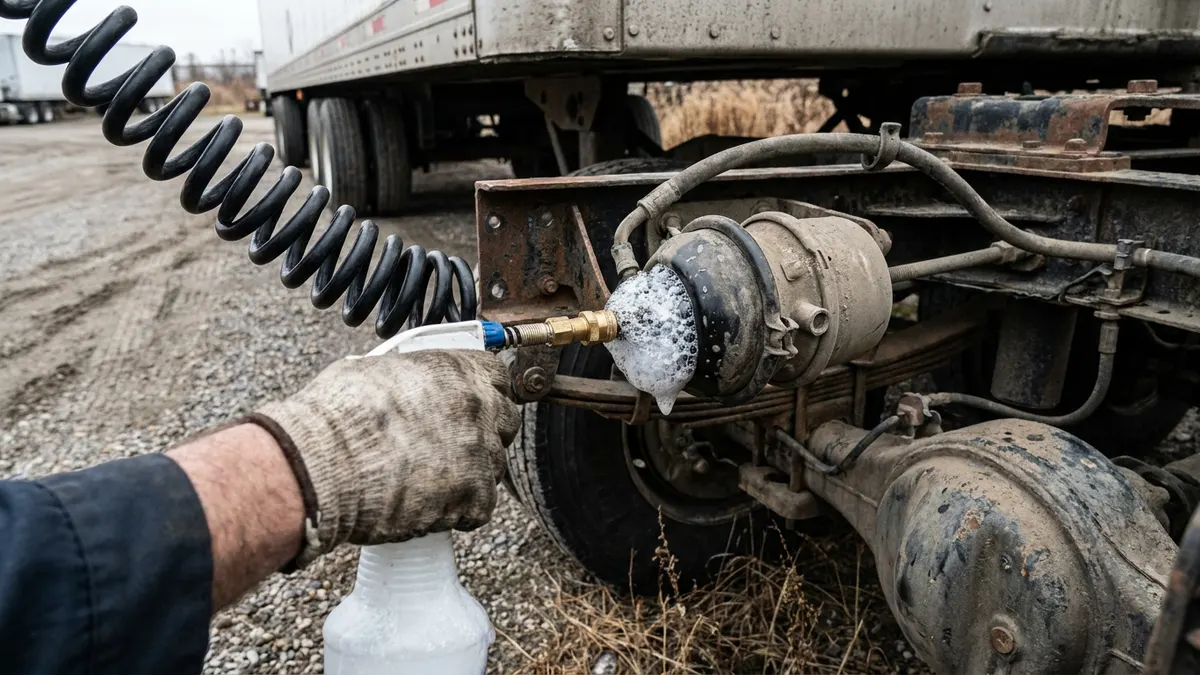
Air brake faults sort into four branches, and naming the branch before you pick up a wrench saves most of the diagnostic time. Watch the dash gauges through one full charge cycle: if the needles will not climb to governor cut-out (roughly 120-135 psi), you have a charging problem; if they climb but drop off after shutdown, you have a leak; if pressure is normal but the brakes hang on or drag, you have a release problem; if the system charges and holds but knocks, squeals, or pushes oil and water downstream, you have a mechanical or contamination problem. Everything below follows those four paths in order.
Set the vehicle up first
Chock the wheels, park on level ground, and let the system charge fully — around 120 psi on a typical highway tractor — before you judge anything. Have a calibrated test gauge, a stopwatch, soapy water in a spray bottle, and the manufacturer's service data on hand. Dash gauges drift with age, and an inaccurate gauge is one of the most common reasons a technician chases a fault that does not exist, so confirm the reading at a tank test port before you condemn any component.
Never work under a vehicle with the spring brakes released and the wheels unchocked. Spring brakes begin to apply mechanically as system pressure falls into the 20-45 psi range, so a leak that develops while you are underneath can set the parking brakes hard or let the vehicle roll.
Related guides: Air Brake Troubleshooting Chart
The top-level flowchart
Start with what the gauges and your ears tell you, then follow the branch across:
| Symptom | Branch | First test |
|---|---|---|
| Pressure climbs slowly or stalls below cut-out | Charging | Time the build-up, then check the governor signal |
| Governor never cuts out, or cycles every few seconds | Control | Governor setting, unloader function, tank leak |
| Builds to cut-out but bleeds down parked | Leakage | Released and applied leak-down rate |
| Pressure normal, brakes slow to release or drag | Release | Pushrod stroke, relay and quick release valves |
| Knocking, squealing, oil or water at the tanks | Mechanical or contamination | Air dryer purge, discharge line, tank drain |
Branch 1: the system will not build pressure
A healthy dual system should recover from roughly 85 to 100 psi in about 45 seconds at fast idle — the figure used in the standard CDL air brake check. If it takes noticeably longer, work outward from the cheap end:
- Drain every reservoir. A tank half full of water and oil sludge cuts usable volume and slows recovery.
- Check the compressor intake. A plugged filter or a collapsed supply hose starves the pump.
- Inspect the discharge line for carbon restriction. A line coked nearly shut is a classic cause of long build times and a hot compressor head.
- Take the governor out of the equation. If the compressor loads normally once the unloader signal is removed, the fault is in the control circuit, not the pump.
- Only then suspect the compressor itself — worn rings, a failed head gasket, or a broken reed valve.
Order matters, because a stuck-open unloader or a mis-set air brake governor mimics a worn-out compressor almost exactly. If the pump really is at fault, the deeper checks are laid out in the guide on a compressor that will not build pressure.
Branch 2: it builds but will not hold
Charge to cut-out, shut the engine off, and time the drop with the brakes released, then again with the service brakes fully applied. The applied test loads the relay valve, foot valve and chamber diaphragms, so a system that holds released but dumps applied points straight at those parts.
| Reference value | Typical figure | What it tells you |
|---|---|---|
| Governor cut-out | 120-135 psi | Top of the charge cycle |
| Governor cut-in | 100-110 psi | Compressor reloads here; a narrow gap means short-cycling |
| Fully charged system | About 120 psi | Normal running pressure on most highway vehicles |
| Low-air warning | Around 60 psi | Buzzer and lamp must both work |
| Spring brake application | 20-45 psi | Parking brakes set mechanically in this window |
| Leak-down, brakes released | 2 psi per minute single unit, 3 psi per minute combination | Standard maximum for a roadworthy vehicle |
| Leak-down, brakes applied | 3 psi per minute single unit, 4 psi per minute combination | Higher loss points to valves or chambers |
Once the rate is outside those limits, hunt the leak by ear with the engine off, then confirm it with soap. Gladhand seals, the air dryer purge valve, chamber diaphragms and the fittings on top of the tanks account for most of what you will find; the shortcuts in locating an air leak quickly save a lot of crawling.
Branch 3: slow release or dragging brakes
If pressure is normal but the brakes stay on, air has a way in and no fast way out. Measure pushrod stroke first — an over-stroked chamber feels like a hanging brake and is an out-of-service item in its own right. Then work the exhaust path: a plugged quick release valve on the steer axle, a relay valve with a fouled exhaust port, a kinked hose, or a return spring, S-cam and slack adjuster seized with rust and old grease. On trailers, a sticking relay or a crimped supply line often shows itself only after the unit has sat overnight.
In freezing weather, add moisture to the list. Water carried past a saturated desiccant cartridge freezes in valve exhausts and small ports, so brakes that drag only on cold mornings usually mean the air dryer has stopped drying.
Branch 4: noise, oil and water
Oil in the tanks, at the dryer purge or sprayed under the exhaust points to a compressor passing oil, a saturated dryer cartridge, or both — and a compressor that pumps oil will keep killing cartridges and fouling valves until it is dealt with. A knock that rises with load usually means a worn connecting rod or a loose drive gear, and it will not improve on its own. Water on its own, with clean air elsewhere, is normally a dryer service item rather than a compressor fault: replace the cartridge on schedule and drain the wet tank until it comes out dry.
Where the flowchart ends
Diagnosis stops being useful once you have isolated the failed part and confirmed it with a measurement rather than a hunch. From there the decision is repair kit or replacement. Unloader, gasket and ring kits are worth fitting to a compressor with good bores and a sound crankshaft; scored cylinders, a cracked head or a knock mean a replacement unit. Either way, match the part to the vehicle's OE number rather than a visual guess — cross-referencing against a catalogue of OE-grade air brake system components is the quickest way to confirm mounting, port layout and displacement before you order.
Finish every repair the same way you started: charge the system, repeat the leak-down test, verify cut-in and cut-out, check the low-air warning, and confirm pushrod stroke at every wheel. A fault that is fixed but never retested is only half diagnosed.
Need the part, not just the answer?
OE-grade air brake compressors and repair kits, manufactured and tested to commercial-vehicle standards.
Shop VADEN partsPublished by VADEN Original. Product links point to the manufacturer’s official catalogue. Specifications are general — always confirm figures against your vehicle’s service manual.