 airbrakecompressor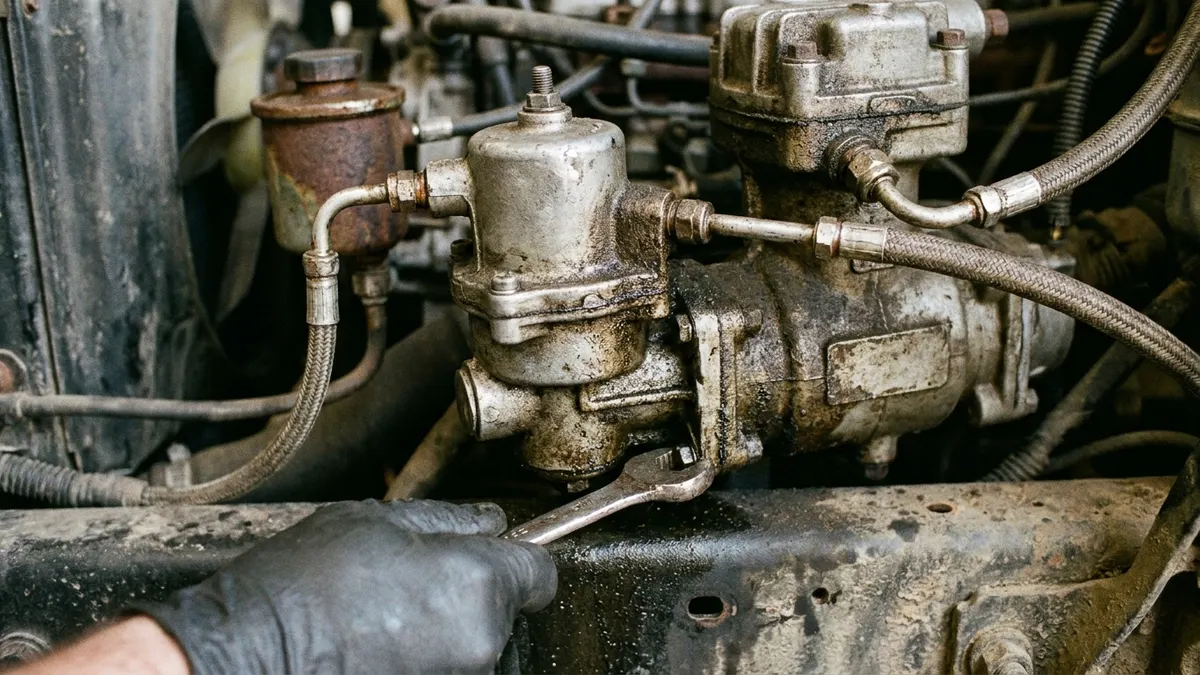
The Bendix D-2 governor is the pressure-sensing pilot valve that tells an air brake compressor when to stop and start building air. It reads pressure from the supply (wet) reservoir and, at cut-out, sends that same reservoir air out to the compressor's unloader mechanism, holding the intake valves open so the compressor free-wheels instead of pumping. When reservoir pressure drops to the cut-in point, the governor vents that unloader line to atmosphere through its exhaust port and the compressor loads again. Everything the D-2 does is pneumatic — there are no electrical contacts and no hydraulic circuit involved.
What the D-2 actually controls
The compressor itself is driven continuously by the engine through gears or a belt. It has no clutch and no on/off switch, so the only way to stop air production is to unload it. The governor is what makes that decision, and on most systems it also pilots a second device: the purge valve on the air dryer. That is why a healthy truck gives the characteristic "pssht" from the dryer at the moment the needle stops climbing — the governor has just pressurized the unloader line and the dryer has purged at the same instant.
Because the D-2 sits upstream of everything, a governor fault imitates a dying compressor almost perfectly. Before condemning a compressor for slow build-up or for running hot, prove the governor. The same logic applies in reverse: a governor that never cuts out keeps the compressor loaded 100 percent of the time, which drives head temperature up, cooks the discharge line, and pushes oil past the rings. See governor not cutting out for that specific fault chain.
Ports and plumbing
The D-2 body is small, but its port arrangement causes more misdiagnosis than any other part of the circuit. Commonly you will find two reservoir ports and two unloader ports (one of each is often shipped plugged for alternate mounting positions), plus an exhaust port protected by a small filter or shield.
| Port | Marking | Function | What goes wrong |
|---|---|---|---|
| Reservoir | RES | Senses pressure from the supply/wet tank | Restricted line or corroded fitting makes the governor read low, so it cuts out late or not at all |
| Unloader | UNL | Sends piloted air to the compressor unloader and, on most trucks, to the air dryer purge valve | Kinked, chafed or leaking line means the compressor never unloads |
| Exhaust | EXH (open) | Vents the unloader line at cut-in | Plugged with road grime, or leaking continuously when the piston seals fail |
| Spare/plugged | — | Alternate routing for accessory piloting | Plug backed out or missing after a previous repair |
The D-2 mounts either directly on the compressor with an adapter and gasket, or remotely on the frame rail or firewall with lines run to it. Remote mounting is convenient for access but adds two more joints that can leak.
Typical pressure settings
Settings vary by chassis manufacturer, so the vehicle's service data always wins over a generic figure. That said, a properly working system falls in a narrow band.
| Point | Typical range | Notes |
|---|---|---|
| Cut-out | 120-135 psi | The only setting adjustable on the D-2 |
| Cut-in | 100-110 psi | Follows cut-out; not separately adjustable |
| Differential | About 20-25 psi | Fixed by the piston and spring design |
| Fully charged system | Around 120 psi | Normal running pressure at the dash gauges |
| Low-air warning | Around 60 psi | Buzzer and light must activate at or above this level |
| Spring brake application | About 20-45 psi | Parking/emergency brakes apply automatically in this band |
Testing a D-2 on the truck
- Tee an accurate test gauge into the supply reservoir. Dash gauges drift, and chasing a governor with a lying gauge wastes a shift.
- Build the system with the engine at fast idle and note the pressure at which the needle stops climbing. That is cut-out. You should hear the dryer purge at the same moment.
- Fan the service brakes down slowly and note where the compressor starts pumping again. That is cut-in.
- With the system charged and the compressor unloaded, listen at the governor exhaust port. Air escaping there continuously means internal seal or valve failure.
- Crack the unloader line at the compressor with the system at cut-out. Strong air flow means the governor is doing its job and the fault is downstream in the unloader itself.
- Repeat the build-up check after any adjustment, and confirm the low-air warning still functions before the truck leaves.
If step 5 shows no air at cut-out, the governor or the reservoir sense line is at fault. If air is present but the compressor keeps pumping, the problem is in the unloader valve assembly on the compressor head.
Adjusting cut-out
Cut-out is changed by removing the top cover, loosening the locknut, and turning the adjusting screw in small steps — roughly a few psi per full turn. Direction and increment are printed in the manufacturer's service data sheet for the specific unit, so check it rather than guessing. Retighten the locknut, refit the cover, and re-verify with the test gauge over at least two full cycles. The differential cannot be adjusted; if cut-in is far outside the normal band while cut-out is correct, the governor is worn internally and needs replacing. Detailed procedure is in our air governor adjustment guide.
Never raise cut-out above the chassis manufacturer's specification to mask a leak or a weak compressor. Relief valves, hoses and the compressor itself are sized for the original setting, and the extra duty cycle shortens compressor life.
Rebuild or replace
Repair kits for the D-2 typically contain piston seals or O-rings, the inlet/exhaust valve assembly, springs, cover gasket and filter. Rebuilding is realistic when the bore and ports are clean and the unit is relatively young. It is a poor bet when the housing is pitted from years of moisture, when the port threads are damaged, or when the truck has a history of oil carryover — contamination will simply attack the new seals. Given the labour involved in retesting, most fleets fit a new governor and move on.
Oil and water reaching the governor is a symptom, not a cause. If the unit is full of sludge, service the air dryer and inspect the compressor before fitting anything new, or the replacement will fail the same way.
Cross-reference and equivalents
The D-2 pattern is the reference design for North American air systems and is found alongside Bendix Tu-Flo series and BA-series compressors on trucks powered by Cummins, Detroit, PACCAR and others. European and many global platforms handle the same job differently: Wabco/ZF and Knorr-Bremse systems often integrate the pressure regulator into the air dryer or the multi-circuit protection valve, so there is no separate governor on the frame rail at all. When cross-referencing, match three things — cut-out setting, port configuration, and mounting pattern — rather than relying on a photo.
Governor problems and compressor problems share the same symptoms, so once the pilot circuit is proven good, the pump itself is the next suspect. VADEN Original supplies OE-grade air brake compressors and repair kits cross-referenced to the major OE part numbers, which is the practical route when a governor test confirms the compressor is at fault. For the broader theory of how the pilot circuit fits the rest of the system, start with our overview of the air brake governor.
Need the part, not just the answer?
OE-grade air brake compressors and repair kits, manufactured and tested to commercial-vehicle standards.
Shop VADEN partsPublished by VADEN Original. Product links point to the manufacturer’s official catalogue. Specifications are general — always confirm figures against your vehicle’s service manual.