 airbrakecompressor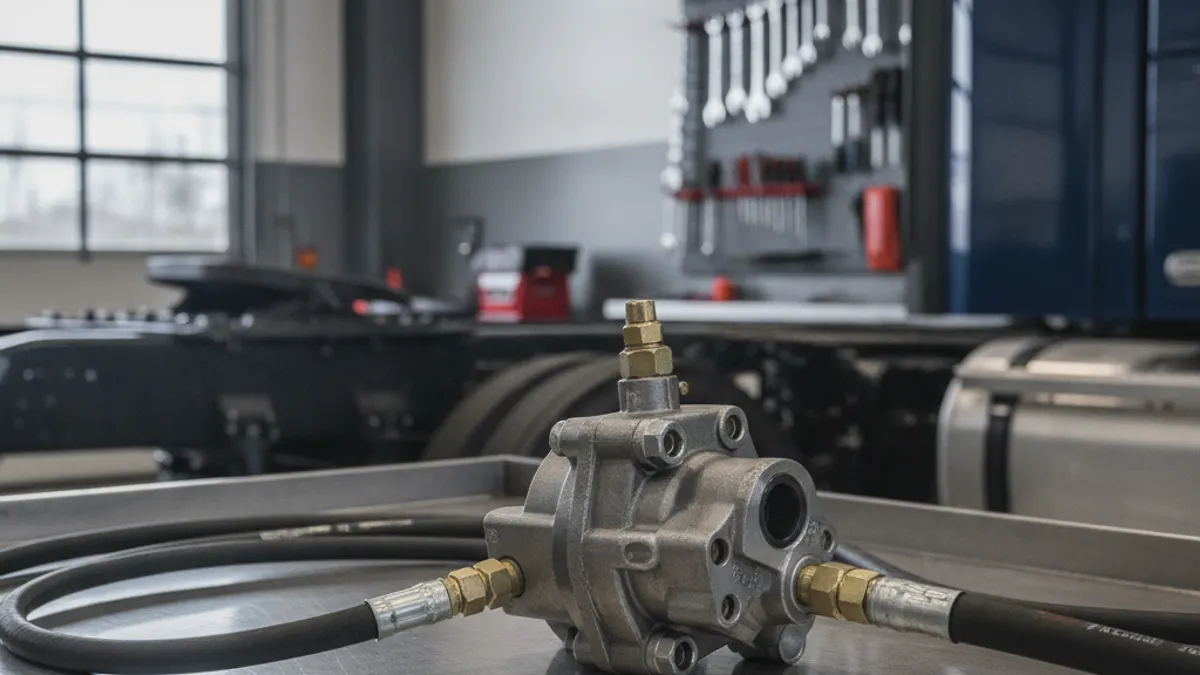
A load sensing valve — commonly called an ALB valve (automatic load-dependent brake force regulator), or LSV — automatically reduces the air pressure delivered to an axle's brake chambers when that axle is lightly loaded, and passes close to full pressure when it is loaded. It sits downstream of the foot brake valve, feeding the relay valve or the chambers directly, on the rear axle of a truck or bus, or on a trailer. Its purpose is to keep braking effort proportional to the weight actually sitting on the wheels, so an empty vehicle does not lock its rear wheels and lose stability. It is a purely pneumatic device on conventional systems — there is no hydraulic circuit involved.
Think of it as a variable pressure limiter that takes its instructions from the suspension. A tri-axle trailer may carry 20-plus tonnes loaded and only a few tonnes empty, yet the brake chambers, slack adjusters and drums are all sized for the loaded case. Without load sensing, the same pedal application that gives a controlled stop at gross weight will skid the tyres on that trailer running empty.
How the valve senses load
Three families are in service. Identify which one you have before touching anything.
| Type | How load is sensed | Typical application | Common failure |
|---|---|---|---|
| Mechanical ALB | Linkage rod and spring or rubber tension element from the valve lever down to the axle or spring seat; suspension deflection moves the lever | Steel leaf-spring trucks and trailers, tippers, older equipment | Seized lever, bent or missing linkage rod, corroded ball joints, broken tension spring |
| Pneumatic (air suspension) ALB | A sensing pipe from the air bellows; bellows pressure is a direct analogue of axle load | Air-suspended tractors, trailers, coaches, city buses | Chafed or kinked sensing line, line left blocked after a bellows change, internal diaphragm leak |
| Electronic load sensing (EBS) | Bellows pressure sensor feeding the EBS modulator; no mechanical valve | Modern EBS tractors and trailers | Sensor or wiring fault logged as a code, usually with a laden-position fallback |
On an air-suspension installation the ALB and the air suspension levelling valve work from the same physical system, so a ride-height problem or a leaking bellows upsets brake balance as well as trim.
What the valve does to the pressure
The valve does not create pressure; it throttles what the driver asks for. At a full brake application, control pressure arriving at the ALB is typically in the region of 100–120 psi (roughly 7–8 bar), depending on how the system is plumbed and how much reservoir pressure the foot brake valve is passing. In the laden position the ALB lets that pressure through with little or no reduction. In the unladen position it limits the output to a fraction of it — on many trailer plates the unladen figure is around a third of the laden control pressure, but the exact input and output pairs are model-specific and are stamped on the ALB data plate. Read the plate; do not assume a number.
Between empty and full the valve gives a proportional characteristic, so a half-loaded trailer receives an intermediate output. Downstream, that trimmed pressure is what the relay valve reproduces at the brake chambers.
Symptoms of a failed or misadjusted ALB
- Wheel lockup and flat-spotted tyres when empty. The classic stuck-laden failure. On an ABS-equipped vehicle you may see no skid marks, but the system will cycle hard on light applications and the driver will feel it in the pedal.
- Long, weak stops when loaded. Valve stuck in or near the unladen position, throttling pressure when it is all needed. Easy to misdiagnose as worn linings or an out-of-adjustment slack adjuster.
- Trailer or rear axle doing no work. Front linings glazing and wearing fast while rear linings look almost new is a strong balance clue.
- Trailer swing or jack-knife tendency on light applications when empty.
- Audible leak at the valve body or the linkage boot, indicating internal diaphragm or O-ring failure, which usually shifts the characteristic as well as leaking.
- Bent, disconnected or wired-up linkage, common on tippers and construction trailers where the rod takes hits from debris.
How to test a load sensing valve
- Chock the wheels and build the system to fully charged — governor cut-out, typically around 120–135 psi, with a fully charged working pressure near 120 psi.
- Find and clean the ALB data plate. Note the required output pressure for each stated control pressure, in both the laden and unladen lever positions.
- Fit calibrated test gauges to the control (input) and delivery (output) ports. On trailers, feed the control line from a hand-controlled application or a test rig rather than guessing at pedal travel.
- Check the sensing input first. Mechanical: move the lever through full travel and confirm the arm swings freely with no binding, no play in the ball joints and an intact tension element. Pneumatic: verify the bellows sensing line is connected, unblocked and at the correct ride-height pressure.
- With the vehicle unladen and at correct ride height, make full and partial applications and compare delivery pressure with the plate figures.
- Move the lever, or apply the plate-specified simulated bellows pressure, to the laden position and repeat. Output should now track input closely.
- Confirm the valve exhausts fully and promptly on release. A lazy release shows up as brakes that drag and overheat.
On many vehicles the ALB setting is a legal brake parameter, not a preference. Set it only to the manufacturer's plate values, unladen, at correct ride height, and record the readings. If the plate is missing or unreadable, obtain the correct data from the vehicle manufacturer before signing the job off.
Replacement, and what to check at the same time
Most ALB failures are either mechanical wear at the linkage or internal seal deterioration, and both are age-related rather than mileage-related. If the body is corroded, the lever is seized, or the output still does not match the plate after correct adjustment, replace the valve — these are not units to rebuild in the field. Replace like-for-like by part number, because the internal characteristic differs between models that look externally identical. VADEN Original supplies OE-grade ALB load sensing valves for trucks and trailers cross-referenced to the major OE numbers.
While the valve is off, do the surrounding work: fit a new linkage rod and joints rather than reusing tired ones, replace a chafed pneumatic sensing line, check the brake chambers and pushrod travel, and verify slack adjuster stroke on the axle concerned. An ALB set perfectly to plate cannot compensate for a foundation brake that is out of adjustment, and a well-adjusted foundation brake will still skid an empty axle if the load sensing is dead. After the job, road test at light and heavy load where possible and check for even lining temperature across the axles.
A note on regional practice
Load sensing valves are near-universal on European-specification trucks, buses and trailers, where a load-apportioning function and a data plate proving its setting are required. In North America, load apportioning is more often handled by brake sizing plus ABS, so a technician crossing between fleets may not expect to find an ALB — but air-suspended trailers, buses and imported equipment do carry them, and an ignored ALB on such a unit becomes an out-of-service defect and a tyre-cost problem.
Source (VADEN Original): ALB Load Sensing Valve: Faults, Replacement & Setting Guide
Need the part, not just the answer?
OE-grade air brake compressors and repair kits, manufactured and tested to commercial-vehicle standards.
Shop VADEN partsPublished by VADEN Original. Product links point to the manufacturer’s official catalogue. Specifications are general — always confirm figures against your vehicle’s service manual.