 airbrakecompressor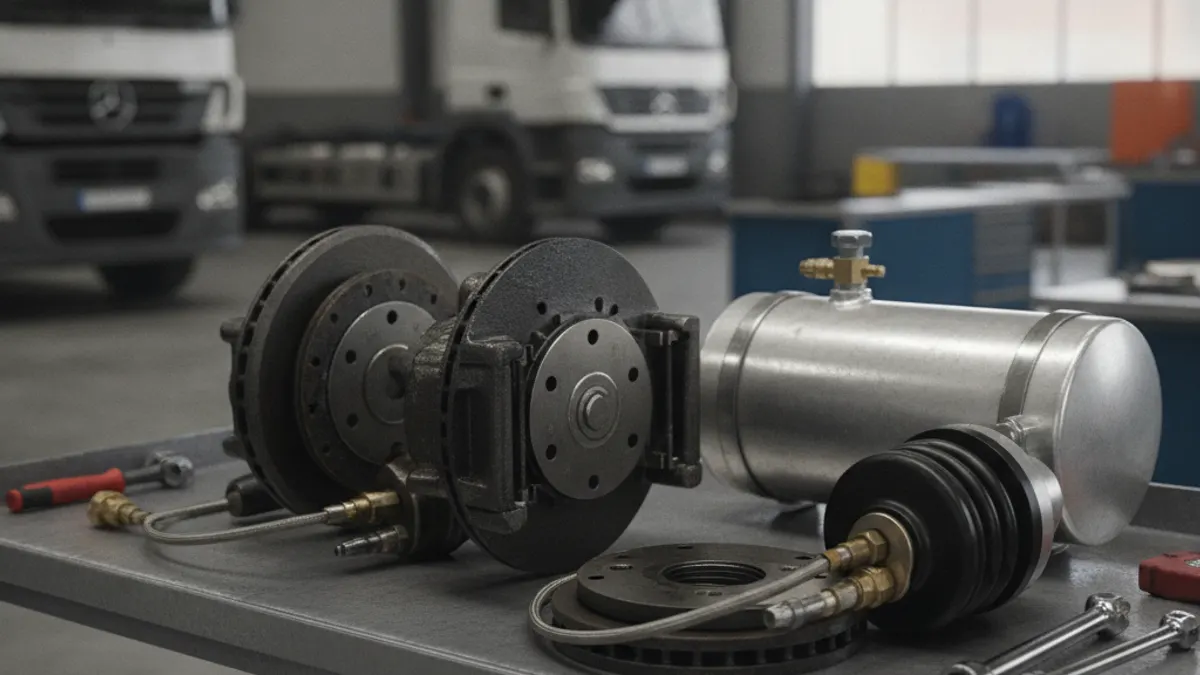
A firm full-service brake application on a typical five-axle tractor-trailer consumes roughly 1 to 3 cubic feet of free air and pulls reservoir pressure down about 10 to 15 psi. Ordinary driving applications — 10 to 25 psi at the treadle — cost far less, often a third of that or under. Because a fully charged system sits near 120 psi and carries reservoir volume many times larger than the brake chambers themselves, the tanks still hold enough air for several more full applications even if the compressor stops producing air entirely.
What actually consumes air in one application
Air brakes are a pneumatic system: pressing the treadle fills the service side of every brake chamber, plus all the delivery plumbing between the relay valves and those chambers. The volume filled is governed by how far each pushrod travels before the linings contact the drum — not by how hard you push. Pressure determines the force and the mass of air consumed; stroke determines the volume.
Approximate displaced volume per chamber, using effective diaphragm area and a realistic in-service stroke:
| Chamber type | Effective area (sq in) | Typical applied stroke (in) | Displaced volume (cu in) |
|---|---|---|---|
| Type 20 | ~20 | 1.25 - 1.75 | ~25 - 35 |
| Type 24 | ~24 | 1.25 - 1.75 | ~30 - 42 |
| Type 30 | ~30 | 1.50 - 2.00 | ~45 - 60 |
| Type 36 | ~36 | 1.50 - 2.25 | ~54 - 81 |
Ten chambers on a three-axle tractor and two-axle trailer might total 400 to 550 cubic inches of chamber volume, and the delivery lines can add another 30 to 60 percent on a long combination. Fill that at, say, 60 psi gauge and you are moving on the order of 1.5 to 2.5 cubic feet of free air. At a light 15 psi application the same stroke happens, but the mass of air drawn from the tanks is far smaller.
This is why brake adjustment shows up as an air problem. Chambers running long stroke on slack adjusters past their readjustment limit displace more volume on every single application, so the compressor works harder on a mountain descent than it should. Adjustment is an air-supply issue before it is ever a stopping-distance issue.
Why a full application only drops the gauge 10-15 psi
In the United States, FMVSS 121 requires the combined volume of the service and supply reservoirs to be at least twelve times the combined volume of all service brake chambers. That ratio is the whole reason air brakes give you repeated stops.
Work the arithmetic on an idealised 12:1 system charged to 120 psi, which is about 135 psi absolute. Open the chambers to the tanks and the same air now fills thirteen parts instead of twelve. Absolute pressure settles near 125 psi, which is roughly 110 psi on the gauge — about a 10 psi drop for a full application. Real systems lose a little more because of plumbing volume, temperature and the trailer supply, so 10 to 15 psi is the honest field number.
Follow that down and you can see how many applications are held in reserve if the compressor stops delivering:
| Starting reservoir pressure | Condition | Full applications remaining before ~60 psi warning |
|---|---|---|
| ~120 psi (fully charged) | System tight, no leaks | roughly 5 - 6 |
| ~100 psi (governor cut-in) | System tight | roughly 3 - 4 |
| ~90 psi | Minor leakage present | 2 - 3, fewer if leaking |
At roughly 60 psi the low-air warning light and buzzer come on, and as pressure keeps falling into the 20 to 45 psi band the spring brakes apply on their own. Those reserve applications exist to get you stopped on the shoulder, not to get you to the next exit.
Everything else that eats air
Service braking is often not the biggest consumer on a working truck. Depending on the spec, the same tanks feed:
- Air dryer purge — every governor cut-out dumps the purge volume to atmosphere, so more cycles means more air thrown away
- Air suspension — levelling valves bleed and refill constantly over rough ground and at every dock
- Cab and seat suspension, air horns and HVAC actuators
- Transmission shift air on range and splitter boxes
- Auxiliary loads — PTO controls, sliding fifth wheels, dump gates, tag axle lifts, air-actuated fan clutches
- Leaks, which on an older combination frequently exceed everything above put together
Because of that shared demand, the tank layout keeps a supply (wet) tank ahead of the primary and secondary service tanks, with protection valving so an accessory failure cannot drain the brake circuits.
Compressor supply and duty cycle
Heavy-vehicle compressors are commonly rated in the 12 to 30 CFM class at governed engine speed, though smaller and much larger units exist. The governor loads the compressor at around 100 to 110 psi and unloads it at around 120 to 135 psi, so the unit only pumps into the tanks part of the time.
The useful metric is duty cycle: the percentage of running time the compressor spends actually building air. A tight, correctly specified system typically sits comfortably under about 25 percent. Sustained duty cycle above that band is the classic cause of high discharge temperatures, carbon build-up in the discharge line, and oil carryover into the dryer and tanks. Fitting a bigger compressor to cure it is treating the symptom.
How to tell if your truck is using too much air
Two measurements separate normal consumption from a fault. The first is leakage. With the engine off, the vehicle chocked and pressure around 90 psi, watch the gauges for one minute:
| Vehicle | Brakes released | Full application applied |
|---|---|---|
| Single vehicle (straight truck, bus, tractor alone) | 2 psi per minute | 3 psi per minute |
| Combination (tractor-trailer) | 3 psi per minute | 4 psi per minute |
The second is build-up. With the engine at fast idle, pressure should climb from about 85 to 100 psi within roughly 45 seconds on a healthy dual system; FMVSS 121 sets a tighter 25-second requirement at maximum governed engine speed. Slow build with acceptable leak-down points to the compressor, the unloader or a restricted discharge line. Fast build with excessive leak-down points at the plumbing, and the fix is to isolate the leak circuit by circuit rather than replace parts on suspicion.
Rule of thumb: if the compressor cycles more than a couple of times per mile of steady highway running, you have a leak or a stuck accessory — not an air consumption problem caused by braking.
Practical takeaways for drivers and fleets
Use the engine brake or retarder to control speed on grades, and reserve the service brakes for measured, firm applications rather than continuous light dragging. Keep slack adjusters in spec so each application displaces only the volume it was designed to. Drain the tanks on schedule so the reservoirs hold air rather than water. And treat any change in cycling rhythm — the interval you expect between governor cut-ins — as an early warning worth investigating before the low-air buzzer makes the decision for you.
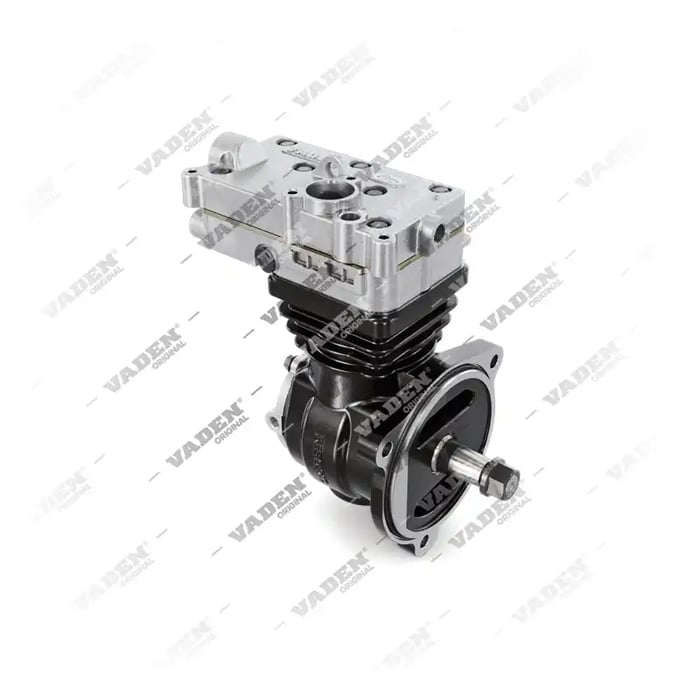
When the cut-in interval keeps shrinking and no leak explains it, the supply side is falling behind demand, and that is the point where replacement air brake compressors solve the problem rather than another round of leak chasing.
Need the part, not just the answer?
OE-grade air brake compressors and repair kits, manufactured and tested to commercial-vehicle standards.
Shop VADEN partsPublished by VADEN Original. Product links point to the manufacturer’s official catalogue. Specifications are general — always confirm figures against your vehicle’s service manual.