 airbrakecompressor
A buzzer and red warning light at key-on is normal on an air brake vehicle. The tanks bleed down while the truck is parked (or you drained them), so system pressure sits below the roughly 60 psi threshold where the low-air warning device activates. Start the engine, let the compressor build, and the buzzer and light should go out somewhere around 60-70 psi, typically within a minute of idling. If the alarm stays on after the gauges read full, or keeps you waiting several minutes, that is no longer normal and needs to be chased down before the truck moves.
Why the warning sounds every cold start
The low-air warning device is a pressure switch, usually one per circuit on a dual system, wired to a buzzer and a dash light. It is normally closed: with no air in the tank the circuit is complete and the alarm is on. It only opens, silencing the buzzer, once pressure rises past its set point. US federal standards require the warning to activate before pressure falls below about 60 psi, so any time the system is under that figure the alarm is doing exactly its job.
Air systems leak a little by design and a little by age. Park a tractor overnight with the compressor stopped and pressure falls off through fittings, valve seats, and the air dryer purge valve. By morning the tanks are often near zero. The sequence you should see every day is: key on, buzzer and light on, engine started, needles climbing, alarm off, spring brakes releasable.
How fast the buzzer should go quiet
Build time is the useful measurement here, not the buzzer itself. The checks technicians and CDL examiners use are below. Run them with the engine at a fast idle, roughly 600-900 rpm, and the wheels chocked.
| Check | Expected value |
|---|---|
| Low-air warning activates | At or above about 60 psi as pressure falls |
| Buzzer and light go out | Shortly above the trip point, roughly 60-70 psi |
| Dual system build rate | 85 to 100 psi in 45 seconds or less |
| Single system build rate | 50 to 90 psi in about 3 minutes |
| Spring brakes stay released | Generally above 60 psi; they set at roughly 20-45 psi |
| Governor cut-out | About 120-135 psi |
| Governor cut-in | About 100-110 psi |
| Normal running pressure | Around 120 psi in a fully charged system |
A healthy truck starting from empty silences the alarm in well under a minute and reaches cut-out in a couple of minutes. If you are standing there waiting three or four minutes for the buzzer to stop, the compressor side deserves a look, and air brake compressor not building pressure covers the usual causes.
Reading the buzzer
| What you observe | Likely meaning | Action |
|---|---|---|
| Buzzer on at key-on, off within a minute of running | Normal overnight bleed-down | None, carry on with the pre-trip |
| Buzzer takes several minutes to stop | Slow build: tired compressor, restricted intake, leaking unloader or governor, large system leak | Time the 85 to 100 psi build, then diagnose |
| Buzzer stays on with gauges reading about 120 psi | Failed pressure switch, chafed wire, bad ground, or a gauge misreading one circuit | Verify both circuits with a known-good test gauge before blaming the switch |
| One gauge needle climbs, the other lags badly | Restriction or leak in one circuit, or a check valve issue | Do not drive; isolate the circuit |
| Buzzer sounds after the truck sat only a few hours | Excessive leak-down | Run a static leak test |
| No buzzer or light at all with empty tanks | Dead warning device, blown fuse, burned bulb | Out-of-service condition, repair before dispatch |
| Buzzer returns while driving | Live leak, or compressor not keeping up with demand | Stop safely while you still have air |
The silent buzzer is worse than the loud one
Drivers get so used to the morning noise that they only notice it when it is missing. A truck that starts up quiet with empty tanks has a warning device that is not working, and that is an out-of-service defect at a roadside inspection. Turn the key on before starting the engine and confirm you get both the audible alarm and the dash light. If you have to drain a tank to bring pressure below 60 psi to prove it, do that, because it is part of a proper air brake check.
A low-air warning that does not warn is a brake defect, not an electrical annoyance. Fix the switch, fuse, or bulb before the truck leaves the yard.
Chasing a buzzer that will not stop
When the alarm stays on at full pressure, work in this order.
- Confirm actual pressure in both circuits with a test gauge at the tank ports. Dash gauges fail, and a stuck needle can make a genuinely low circuit look full.
- Check whether the compressor reaches governor cut-out. If it never cuts out, the buzzer may be telling the truth about a circuit that is bleeding away.
- Inspect the wiring at the low-pressure switches. These sit on the wet or primary tank and live in road spray, so corroded spades and chafed leads are common.
- Unplug one switch at a time. If the alarm drops out when a given switch is disconnected, that switch is holding the circuit closed.
- Replace the switch with the correct thread and pressure rating, then re-test from empty so you can watch the exact pressure at which it clears.
Deeper electrical and switch-level troubleshooting is covered in low air warning won't turn off.
When it is really a leak
If the buzzer greets you after the truck has only been parked a few hours, measure the leak-down instead of guessing. With the engine off, pressure built up, wheels chocked and brakes released, the accepted limits are roughly 2 psi per minute for a straight truck and 3 psi per minute for a combination. With the service brakes applied, roughly 3 and 4 psi per minute respectively. Anything faster means air is escaping somewhere it should not: glad hands, chamber diaphragms, valve exhaust ports, or fittings. Tracking down pressure loss is a soapy-water-and-patience job, and the leak is usually audible once the cab is quiet.
Bottom line
Treat the start-up buzzer as a daily self-test rather than a fault. It should sound, it should stop promptly as pressure passes roughly 60 psi, and the system should reach cut-out at about 120-135 psi without drama. Anything that departs from that pattern, whether too slow, too quiet, or never-ending, is the air system warning you before it strands you.
A buzzer that never stops usually means the charging side is not keeping up, and because the governor, dryer and purge often live together, the repair is a complete air processing unit rather than a single valve.
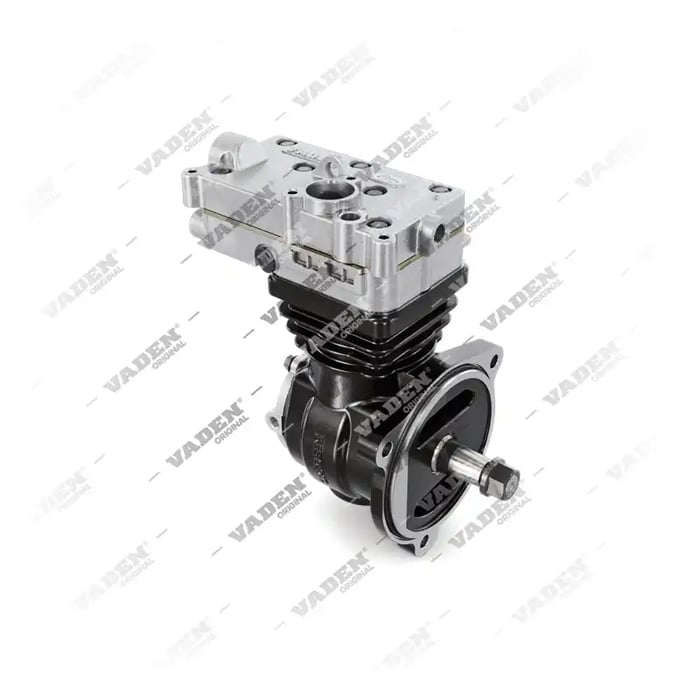
Need the part, not just the answer?
OE-grade air brake compressors and repair kits, manufactured and tested to commercial-vehicle standards.
Shop VADEN partsPublished by VADEN Original. Product links point to the manufacturer’s official catalogue. Specifications are general — always confirm figures against your vehicle’s service manual.