 airbrakecompressor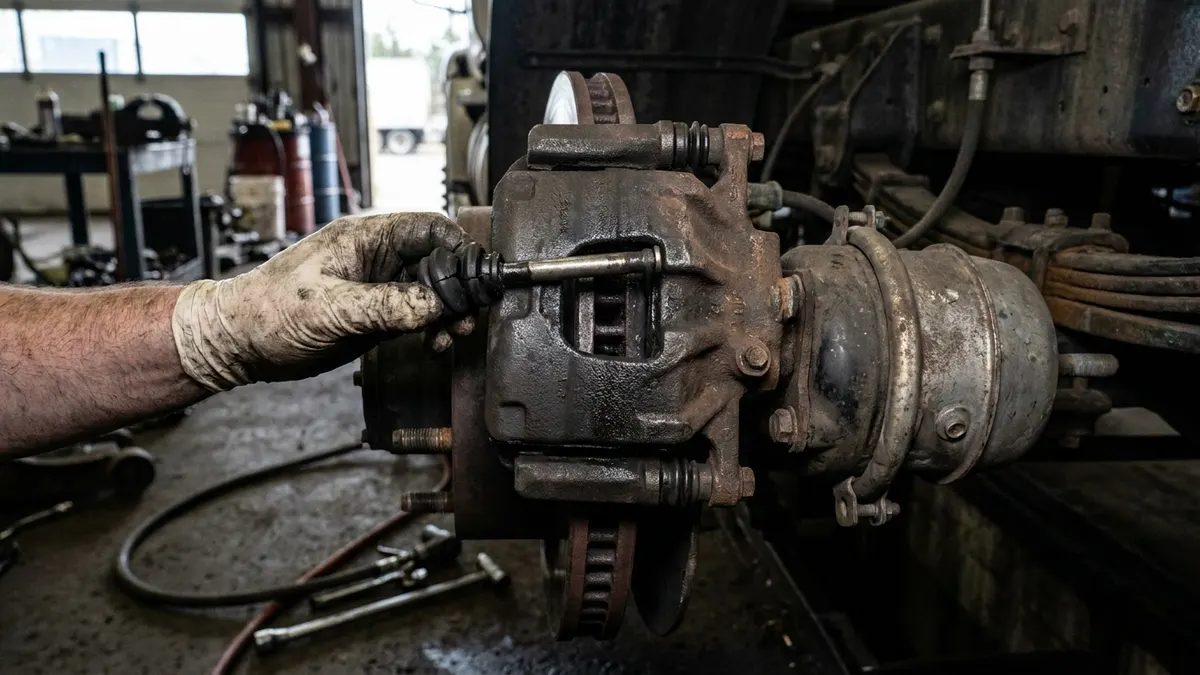
On a heavy truck, "brake pads" means air disc brake (ADB) pads: a block of friction material bonded to a steel backing plate that a pneumatically actuated caliper clamps against a ventilated rotor. Replace them when the friction material is down to roughly 2-3 mm, and know that in the United States an air disc pad worn below 3.2 mm (1/8 in) is an out-of-service defect. Pads go in as complete axle sets — inboard and outboard, both wheel ends — and the rotor is measured at the same visit, because a worn or cracked rotor will ruin a fresh set of pads in short order.
How the pad is actually loaded
There is no brake fluid in this system. Service air enters the brake chamber, the pushrod swings a lever and eccentric shaft inside the caliper, and that mechanism multiplies chamber force into one or two tappets that drive the inboard pad into the rotor. The caliper body then slides on its guide pins and pulls the outboard pad in from the other side. An adjuster inside the caliper holds running clearance to a fraction of a millimetre and takes up wear automatically, so unlike an S-cam brake there is nothing to adjust by hand and no pushrod stroke that grows as the friction wears down.
Pad condition does not change your air pressures. A healthy system still cuts out around 120-135 psi, cuts back in around 100-110 psi, sits fully charged near 120 psi, trips the low-air warning near 60 psi, and lets the spring brakes apply somewhere in the 20-45 psi range as pressure falls away. If you are chasing a charging or leak complaint, the pads are not the cause.
Pad compounds and what they change
Every heavy-vehicle pad sold today is asbestos-free, but formulations still differ, and the compound is the biggest single factor in how the brake behaves when it is hot.
- Low-steel / semi-metallic — steel and iron fibres in a resin matrix. This is the common line-haul OE compound: stable friction at high rotor temperature and good fade resistance, at the cost of faster rotor wear, more dust, and a greater tendency to squeal when cold.
- Non-asbestos organic (NAO) — aramid, mineral and rubber fillers with little or no steel. Quieter, easier on the rotor and better cold bite, but it gives up some high-temperature stability, so it suits urban and vocational duty better than long mountain grades.
- Hybrid and low-copper blends — where most compounds are heading. US "better brakes" legislation is phasing copper content down, and replacement pads sold in Europe must carry an ECE R90 approval mark showing they were tested against the OE friction level.
Do not mix compounds across an axle. Two different friction levels on the same axle produce a side-to-side imbalance that shows up as a pull under hard braking and as uneven pad and rotor temperatures afterwards.
Wear indicators and minimum thickness
There are three ways to read remaining pad, and a thorough inspection uses all of them. Sight the pad through the caliper opening and measure at the thinnest point, not the fattest. Check the mechanical indicator — a pointer, notch or scale on the caliper that moves as the internal adjuster takes up wear. And on equipped trucks, watch for the electronic wear sensor, a loop moulded into the pad that lights a dash warning when the friction is nearly gone.
| Check | Typical figure | Action |
|---|---|---|
| New friction material | About 18-23 mm above the backing plate, depending on caliper size | Baseline for calculating remaining life |
| Plan the change | Around 5 mm remaining | Order pads and hardware, book the shop time |
| Manufacturer minimum | Commonly 2-3 mm remaining — confirm against the caliper maker's spec | Replace now |
| US out-of-service limit | Less than 3.2 mm (1/8 in) of friction material | Vehicle is parked until repaired |
| Inboard vs outboard difference | More than about 3 mm | Suspect seized guide pins, torn boots or a sticking adjuster |
| Rotor thickness | Roughly 45 mm new on a typical 430 mm rotor, with a discard limit near 37 mm | Measure at the most worn point; replace at or below the limit |
| Rotor condition | Cracks running to either edge, blue heat spots, heavy scoring or a lip | Replace the rotor with the pads |
Figures vary by caliper family — Bendix, Knorr-Bremse, ZF (Wabco) and Meritor calipers each use their own pad shape, retention hardware and service limits. The axle or caliper manufacturer's current service literature always outranks a generic chart.
Why pads and rotors are replaced as a set
New pads bed themselves to whatever surface they find. Drop a fresh set onto a scored, cracked or dished rotor and the pad contacts on high spots only: less effective area, higher local temperature, hot spotting, judder, and a pad set that wears out well before its time. That is why a pad job is really a wheel-end job.
- Both wheel ends of the axle, inboard and outboard pads together — four pads minimum per axle.
- Rotors measured, not eyeballed. Most heavy-duty ADB rotors are not intended to be turned or refaced, so the decision is usually replace or keep, not machine.
- The hardware in the kit — retainer bar, pad springs, pins and clips — goes on new. Reused springs let the pads rattle and chatter.
- Guide pins, boots and caliper seals get inspected. If the pins are seized or the adjuster will not wind back, the pad set is not the fix; a reman or new unit from a proper range of heavy-duty air disc brake calipers and caliper components is. More detail on the unit itself is in the air disc brake caliper guide.
- Bed the new set in with a series of moderate stops from moderate speed before the truck sees a loaded grade.
How disc pads differ from drum linings
| Aspect | Air disc pads | S-cam drum linings |
|---|---|---|
| Adjustment | Automatic, inside the caliper; no external adjustment | Slack adjuster; pushrod stroke must be checked and stay within limits |
| Wear check | Measure friction thickness or read the caliper indicator | Measure lining at the thinnest point, and against rivet heads on riveted shoes |
| Friction area | Smaller, worked harder, higher operating temperature | Larger area, more thermal mass, more prone to fade as the drum expands |
| Assist effect | None — clamping force is what the caliper produces | Self-energising, so output varies more with lining condition and drum finish |
| Service time | Pads out in minutes once the caliper is opened | Full shoe, spring and hardware job at the wheel end |
| Contamination | Open design sheds water and grit quickly | Enclosed; grease from a failed seal soaks the lining |
If you are weighing the two systems for a spec sheet, the trade-offs are laid out in air disc versus drum brakes, and the drum side of the job is covered in truck brake shoes and linings.
Doing the job right
- Park on level ground, chock the wheels and drain the tanks only as the procedure requires — the vehicle must stay controlled throughout.
- Release the parking brake at that wheel end by caging the spring brake, so the caliper adjuster can be wound back.
- Remove the retainer hardware, wind the adjuster back with the correct tool, and pull both pads.
- Measure the rotor, inspect guide pins and boots, and check for a wet chamber, a leaking hub seal or a chafed air line while everything is open.
- Fit the new pads and new hardware, cycle the brake several times on air to re-set the running clearance, un-cage the chamber, and confirm the wheel turns freely with no drag.
Then verify the whole axle: even pad depth side to side after a road test, no hot wheel end, no warning lamp. A pad that is already wearing crooked after a hundred miles is telling you the caliper or the wheel end, not the friction, is the real problem.
Need the part, not just the answer?
OE-grade air brake compressors and repair kits, manufactured and tested to commercial-vehicle standards.
Shop VADEN partsPublished by VADEN Original. Product links point to the manufacturer’s official catalogue. Specifications are general — always confirm figures against your vehicle’s service manual.