 airbrakecompressor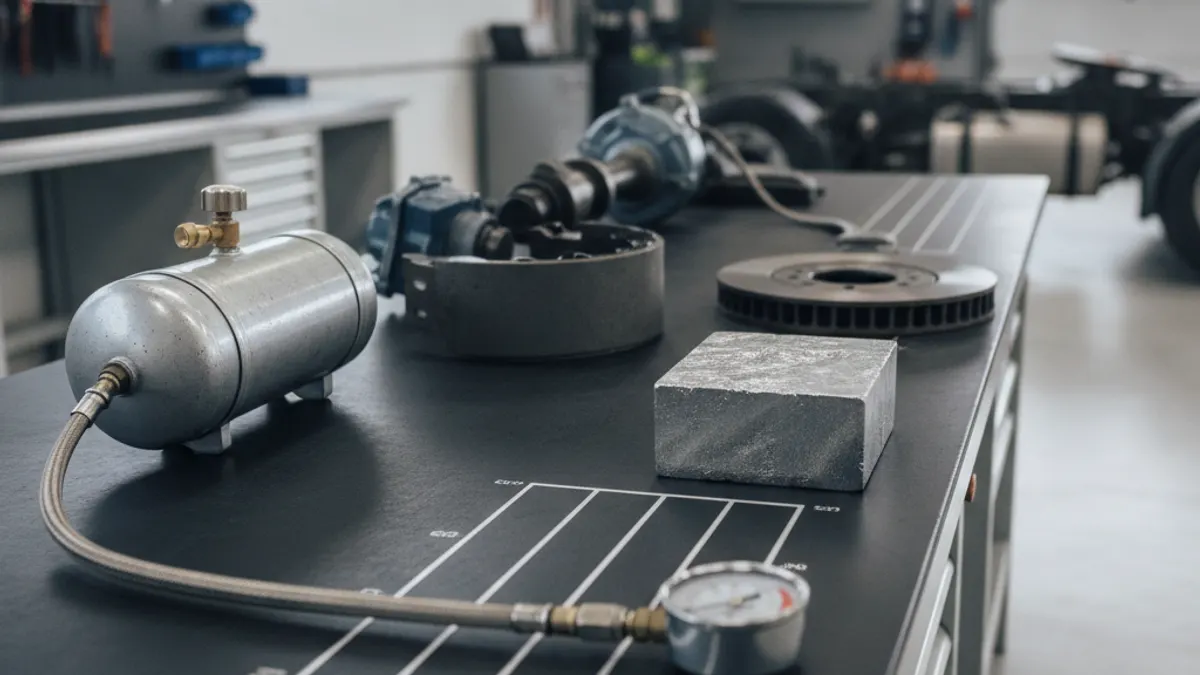
Total stopping distance on an air-braked truck is the sum of four things: how long it takes you to see the hazard (perception distance), how long it takes your foot to move (reaction distance), how long the air takes to reach and fill the brake chambers (brake lag distance), and how far the vehicle travels once the brakes are actually working (effective braking distance). Hydraulic car brakes have only three of those, because fluid is incompressible and acts almost immediately. Air is a pneumatic signal that has to travel down the lines, open valves and fill volume before any force appears. That extra lag runs about 0.4 to 0.5 second, roughly 32 ft of pavement at 55 mph, and it is the single biggest reason air brakes feel and behave differently from anything on a car.
The four parts of the stop
Break a stop into its components and it becomes obvious why a loaded combination needs so much room, and which parts a technician can actually influence.
| Component | What is happening | Typical time | Approx. distance at 55 mph |
|---|---|---|---|
| Perception distance | Eyes and brain register the hazard | about 1.75 seconds | about 140 ft |
| Reaction distance | Foot leaves the throttle and hits the treadle valve | about 0.75 second | about 60 ft |
| Brake lag distance | Air reaches and fills the chambers, pushrods move, shoes meet drums | about 0.4-0.5 second | about 32 ft |
| Effective braking distance | Friction actually slowing the vehicle | varies with weight, grade, surface | about 215 ft |
Add them up and a healthy loaded rig at 55 mph is looking at roughly 450 ft from hazard to standstill - about one and a half football fields. Only the last two lines are mechanical. The first two belong to the driver, and no amount of new hardware shortens them.
Why brake lag is unique to air brakes
When you press the treadle you are not pushing brake force down a line, you are sending a pneumatic command. That signal has to travel the length of the vehicle, open the relay valves, and then fill every chamber with enough volume to overcome the return springs and take up shoe-to-drum clearance. The signal moves quickly, but the filling takes time, and time at highway speed is distance.
Two design details keep the lag manageable. Relay valves mounted near the axles treat the treadle signal as a command only, then feed the chambers from the nearest reservoir instead of pushing air all the way from the cab. Electronic braking systems go further, sending the command electrically and using air purely for the muscle. If a truck feels like it takes a beat too long to bite, that is a maintenance symptom worth chasing rather than a quirk to live with - see brake lag and slow brake response for the usual culprits.
What makes lag worse than it should be
- Excessive pushrod stroke, so the chamber spends air and time taking up slack before force reaches the cam.
- Kinked, undersized or restricted air lines and clogged fittings.
- A relay valve slow to crack open, or a trailer plumbed without one.
- System pressure sitting low because the compressor or governor is not holding a full charge.
- Leaks that drop pressure the moment a full application is made.
Stopping distance by speed
Perception, reaction and lag distance rise in a straight line with speed. Braking distance does not - it rises with the square of speed, so going from 30 to 60 mph roughly quadruples that portion. The figures below assume dry, level pavement, a loaded combination, correctly adjusted brakes and an alert driver. Treat them as planning numbers, not promises.
| Speed | Perception + reaction | Brake lag | Effective braking | Approx. total |
|---|---|---|---|---|
| 30 mph | about 110 ft | about 18 ft | about 65 ft | about 190 ft |
| 40 mph | about 145 ft | about 23 ft | about 115 ft | about 285 ft |
| 55 mph | about 200 ft | about 32 ft | about 215 ft | about 450 ft |
| 65 mph | about 240 ft | about 38 ft | about 300 ft | about 575 ft |
On wet pavement expect to need substantially more room, and on packed snow or ice several times more. Traction, not brake force, becomes the limit, and a wheel can lock long before the system uses all the pressure available to it.
Certification distance is not real-world distance
Federal reduced stopping distance rules require most new three-axle tractors to stop from 60 mph within 250 ft at test weight, with a longer allowance for heavy and severe-service tractors. Those numbers come from a controlled test: professional driver, high-friction surface, brakes at test temperature, and the clock starting at brake application. Perception and reaction are excluded entirely. That is why a spec sheet can say 250 ft while the practical figure a driver has to leave at highway speed is closer to 450 ft.
What stretches stopping distance in service
- Brake adjustment. A pushrod past its readjustment limit is doing less work, and one weak axle transfers load onto the others. Adjustment is the cheapest stopping distance there is.
- Heat. Hot drums and glazed linings lose friction, which is why engine braking should carry a long descent. More on brake overheating and fade.
- Low system pressure. A fully charged system sits around 120 psi, with the governor cutting out roughly 120-135 psi and cutting back in around 100-110 psi. If pressure sags, chamber force sags with it.
- Load state. An empty trailer stops differently, not always better - light axles lock early and the ABS spends its time releasing pressure rather than applying it.
- Tires and drums. Worn tread, mismatched drum diameters and contaminated linings all take bite away.
- Trailer timing. If trailer brakes come on late, the tractor works alone for the first fraction of a second and the combination gets unstable.
Keeping stopping distance where it belongs
None of this needs exotic equipment. Measure pushrod stroke at every service and correct anything at or past the limit for that chamber type. Fix leaks rather than living with them; the compressor benefits too. Keep the air dry so valves respond crisply in cold weather. Confirm during the seven-step air brake check that the low-air warning comes on around 60 psi and that the spring brakes set somewhere in the 20-45 psi range as pressure falls. Then drive to the numbers above, add margin for weight, grade and weather, and remember that the first two and a half seconds of any stop are pure geometry - the truck is still travelling at road speed and nothing mechanical has happened yet.
Once the air has arrived, the rest of the stop is friction: worn, glazed or under-specified shoes lengthen the braking phase itself, so match brake linings to the axle load and duty the truck actually runs.
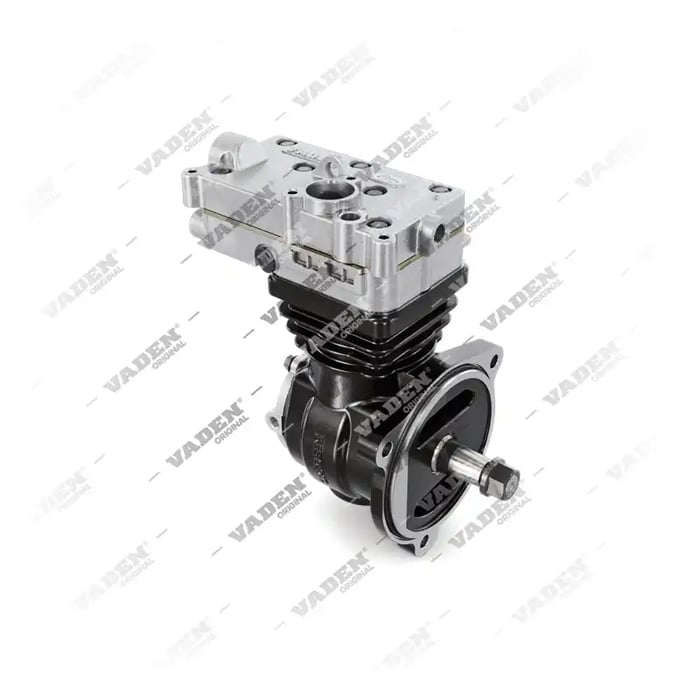
Need the part, not just the answer?
OE-grade air brake compressors and repair kits, manufactured and tested to commercial-vehicle standards.
Shop VADEN partsPublished by VADEN Original. Product links point to the manufacturer’s official catalogue. Specifications are general — always confirm figures against your vehicle’s service manual.