 airbrakecompressor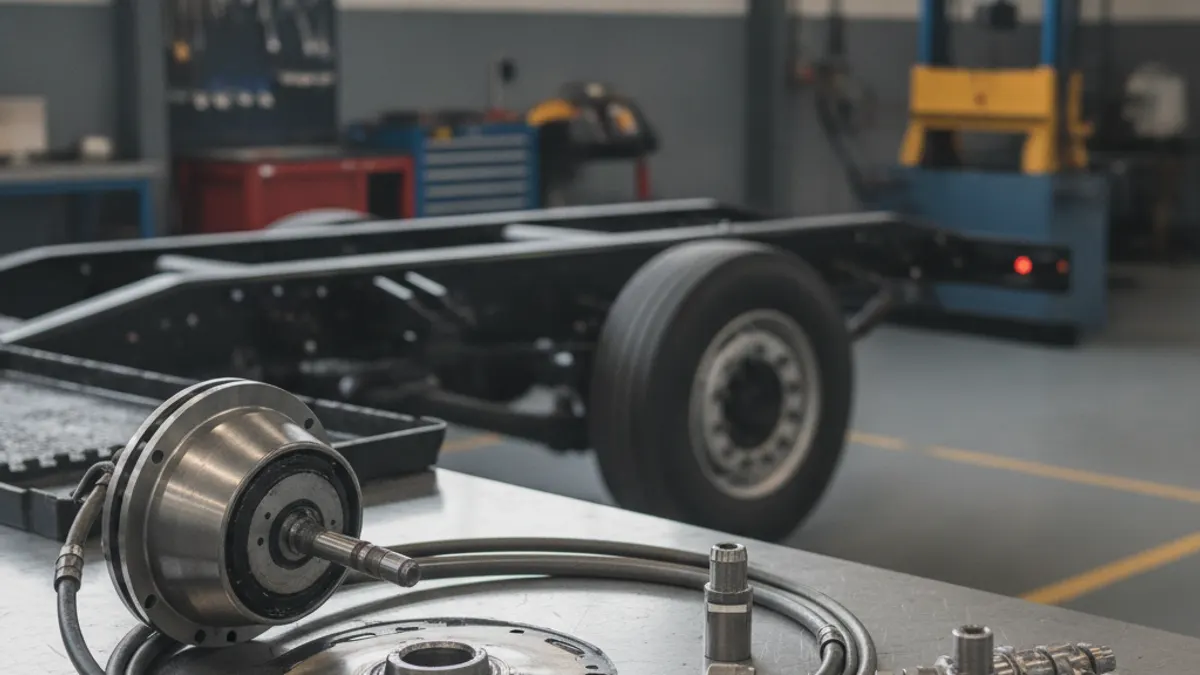
In the United States there is no standalone "air brake endorsement." Instead, a commercial driver's license (CDL) starts with an air brake restriction (code L), and you remove that restriction by passing the air brake knowledge test and taking your skills test in a vehicle equipped with air brakes. If the L restriction stays on your license, you are legally barred from operating any commercial vehicle whose braking system relies on air. Because the rule comes from the federal government (FMCSA), it is the same in every state — the "by state" part is about where you test, not about differing standards.
This trips up a lot of new drivers who assume air brakes work like an add-on you bolt onto a Class A. It's the reverse: the license assumes you can't use air brakes until you prove you can.
Restriction vs. endorsement: why the wording matters
Endorsements add privileges — hazmat (H), tanker (N), passenger (P), school bus (S). Restrictions subtract them. The air brake requirement is a restriction because the default assumption for any commercial vehicle is that it uses air brakes, so the license limits you until you demonstrate competence. Clear the tests and the restriction simply comes off; there is no separate endorsement card or code to earn.
| Feature | Endorsement | Air brake restriction (L) |
|---|---|---|
| Effect on license | Adds a privilege | Removes or limits a privilege |
| How it appears | Letter code added (H, N, P, S) | Letter code L present until cleared |
| Goal for the driver | Earn the code | Remove the code |
| Test type | Knowledge (sometimes skills) | Knowledge plus in-vehicle skills |
How you end up with the L restriction
The FMCSA rule is specific. A state must place the air brake restriction on your CDL if any of these are true:
- You fail the air brake knowledge test (the written portion covering how the system charges, warns, and applies).
- You take your skills (road) test in a vehicle that is not equipped with air brakes — for example, an air-over-hydraulic exception vehicle or a straight hydraulic-braked truck.
- You cannot perform the in-cab air brake checks during the pre-trip inspection and the applied and static air-loss portion of the exam.
In other words, the restriction is the default outcome unless you affirmatively demonstrate air brake competence on a compliant vehicle. If you learn on a truck without a real air system, you'll get the restriction even if you pass everything else.
What the air brake test actually covers
The knowledge portion expects you to understand the pneumatic system, not car-style hydraulics. Examiners want to hear correct behavior in ballpark ranges, not memorized exact numbers. Practically, you should be fluent in:
System operation
- The compressor builds pressure; the governor cycles it, cutting out around 120–135 psi and cutting back in near 100–110 psi.
- A properly charged system sits around 120 psi, and the low-air warning must activate by roughly 60 psi.
- Spring (parking) brakes apply automatically as system pressure falls into the roughly 20–45 psi range — the fail-safe that stops a truck that loses air.
The in-cab checks
The skills test includes a static leak test and an applied leak test with the engine off, plus verifying the low-air warning and the spring-brake pop-out. You'll also time how fast the compressor rebuilds pressure. These are the same checks that live inside the seven-step air brake check, so learning that routine cold is the fastest way to pass.
Removing an existing L restriction
If you already hold a CDL with the L restriction and want to clear it, you don't start over — you go back to the licensing office and take the skills test again in a vehicle that has a full air brake system. Pass the pre-trip air checks and the road portion in that vehicle, and the state reissues your license without the L code. There's no waiting period beyond scheduling, and no separate endorsement fee structure; it's a re-test of the skills exam on the correct equipment.
The single most common reason drivers carry the restriction unnecessarily is testing in the wrong truck. If your CDL school or employer road-tests you in a hydraulic or air-over-hydraulic vehicle to make the test easier, you inherit a restriction that limits nearly every real trucking job. Confirm before test day that the exam vehicle has genuine air brakes.
Is it really the same in every state?
Yes. The CDL program is federally standardized, so the air brake restriction, the knowledge test topics, and the skills requirements are uniform nationwide. What varies is purely administrative — where you schedule, appointment availability, third-party tester rules, and local fees. A driver removing the restriction in Texas faces the same technical standard as one in Ohio. The phrase "air brake endorsement by state" mostly reflects people searching for their local DMV process, not different laws.
How other countries handle air brakes
Most countries don't use the US restriction model. Instead, the ability to drive air-braked commercial vehicles is bundled into the heavy-vehicle license class itself, or handled as a code added to the license.
| Region | How air brakes are licensed |
|---|---|
| United States | Restriction (code L) on the CDL; removed by testing on an air-equipped vehicle |
| Canada | Separate air brake endorsement (commonly the "Z" or provincial air brake code) earned by a dedicated course and test |
| United Kingdom and EU | No separate air brake qualification; competence is assumed within the C, C1, and D truck and bus categories |
| Australia | Air brakes covered within heavy-vehicle license classes; no standalone endorsement |
Canada is the closest to a true "endorsement" — several provinces require an explicit air brake course and a Z-code (or equivalent) before you can operate air-braked equipment, whether or not you hold a commercial license. The UK, EU, and Australia treat air brake operation as an inherent part of qualifying for the larger vehicle category, so the training is embedded rather than separated out.
Bottom line for US drivers
Treat the air brake restriction as something to eliminate before you ever look for work, because a CDL with the L code shuts you out of most tractor-trailer and transit jobs. Study the pneumatic system properly, master the in-cab checks, and — critically — make sure your skills test happens in a vehicle with a real air brake system. Do that and the restriction never appears in the first place. For the exam routine itself, see the CDL air brake test guide, and understand the equipment you're being tested on with how air brake systems work.
Need the part, not just the answer?
OE-grade air brake compressors and repair kits, manufactured and tested to commercial-vehicle standards.
Shop VADEN partsPublished by VADEN Original. Product links point to the manufacturer’s official catalogue. Specifications are general — always confirm figures against your vehicle’s service manual.