 airbrakecompressor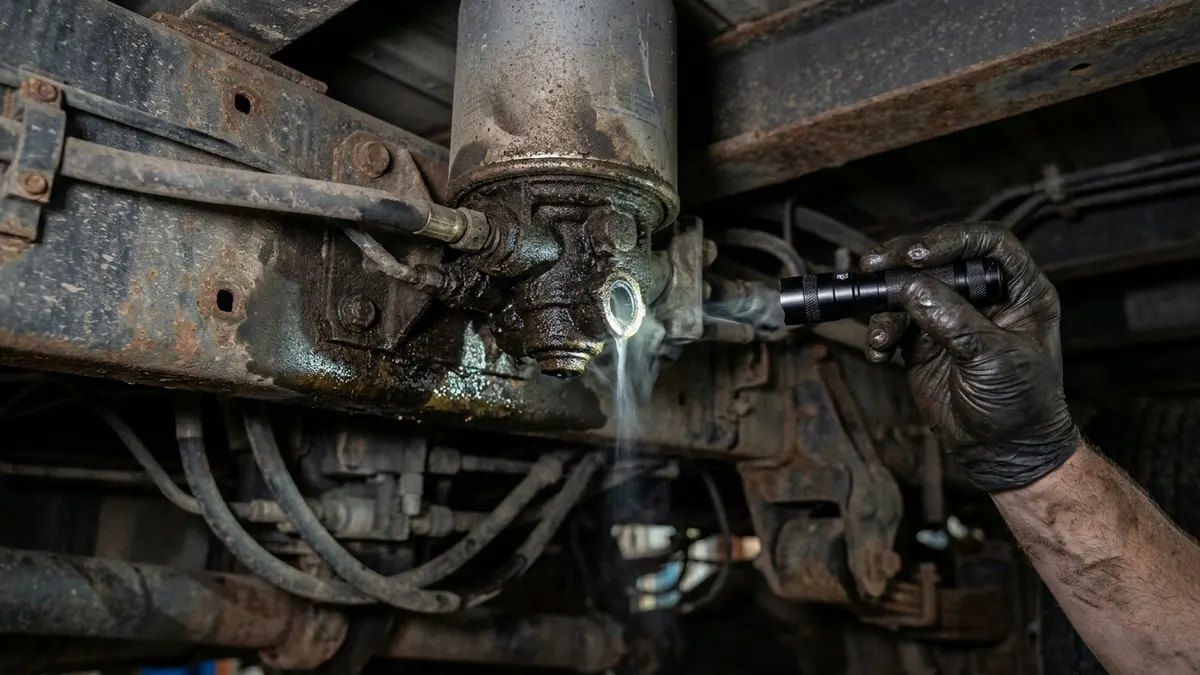
The air dryer purge valve is the exhaust valve in the bottom of the dryer's end cover, and it is the part that actually empties the dryer. When the governor reaches cut-out — normally somewhere between 120 and 135 psi — it sends a control signal that unloads the compressor and opens the purge valve, dumping the water, oil and sludge collected in the dryer sump in one sharp blast, then reverse-flowing a small volume of dry air back through the desiccant to strip the moisture out of it. If that valve leaks, sticks closed or ices up, the dryer stops protecting the system: you either bleed air continuously out of the exhaust port, or you push water and oil downstream into the tanks and control valves.
How the purge cycle works
An air dryer is not a passive filter. It works only because it is emptied and regenerated on every governor cycle, and the purge valve is what makes that happen. The sequence below is essentially the same on every spin-on cartridge dryer, whatever the make.
| Stage | Governor | Purge valve | What you hear |
|---|---|---|---|
| Charging | Control line vented | Seated closed; air passes through the desiccant to the tanks | Compressor working, no exhaust |
| Cut-out (120-135 psi) | Sends control pressure to the compressor unloader and the dryer | Snaps open to atmosphere, sump blows down | One hard, sharp blast |
| Purge / regeneration (about 10-30 s) | Control pressure held | Stays open while dry air from the purge volume back-flows through the desiccant | A softer, decaying hiss |
| Standby, compressor unloaded | Control pressure held | Open, dryer at 0 psi | Silence — no weeping |
| Cut-in (100-110 psi) | Vents the control line | Closes, dryer recharges | Compressor loads back up |
Two points matter here. First, the purge valve is not commanded by the dryer at all — it obeys the air brake governor through the control line, so a governor fault or a blocked control line looks exactly like a dead purge valve. Second, the outlet check valve above the desiccant is what stops supply tank air from rushing back out of the open exhaust; when that check valve passes, the symptom shows up at the purge port even though the purge valve itself is fine. For the wider picture of where the unit sits in the circuit, see how the air dryer for trucks is plumbed.
Symptoms of a failing purge valve
| Symptom | Most likely cause | First check |
|---|---|---|
| Constant air leak at the dryer exhaust, compressor cycling frequently | Purge valve seat or o-ring worn, or held open by carbon and desiccant dust; leaking outlet check valve | Soap the exhaust port after the purge has finished |
| No purge sound at cut-out | No control signal, purge valve stuck closed, or ice in the end cover | Crack the control line at the dryer at cut-out and look for pressure |
| Water in the tanks despite a "working" dryer | Dryer never purging, purging too briefly, or saturated desiccant | Drain the wet tank and look for water and emulsified oil |
| Purging every few seconds while parked | Leak downstream causing rapid governor cycling | Find the leak first — the dryer is only reacting |
| Purges correctly but weeps between cycles | Purge valve seat or outlet check valve passing | Soap the port with the system fully charged, engine off |
| Exhaust frozen open or shut in winter | Failed heater element or thermostat in the end cover | Ohm the heater and check thermostat continuity when cold |
Constant leakage is the failure that gets trucks towed. A purge valve that will not seat drags system pressure down, keeps the compressor loaded almost continuously, and eventually trips the low-air warning near 60 psi. Keep driving on that and pressure will fall into the band where the spring brakes begin to apply, roughly 20 to 45 psi. Treat a dryer exhaust that never stops hissing as a system-down fault, not a nuisance.
Testing the purge valve on the truck
- Build to cut-out and listen. You should hear one sharp exhaust, then a decaying hiss, then silence.
- With the system fully charged (around 120 psi) and the compressor unloaded, spray the exhaust port with soap solution. Steady bubbles mean the purge valve is not seating or the check valve above it is passing.
- Fan the pressure down to cut-in and confirm the valve closes as the compressor loads. A valve that keeps exhausting while the compressor builds is stuck open.
- If nothing purges at all, crack the control line fitting at the dryer at cut-out. Pressure there means the governor is doing its job and the fault is inside the dryer; no pressure sends you back to the governor or the line itself.
- In cold weather, test the heater and thermostat before buying parts. A frozen purge valve behaves exactly like a mechanically failed one.
Never open a dryer, end cover or purge valve until the system is fully drained. The sump can hold pressure with the engine off, and end cover retaining rings under spring load have injured technicians.
Purge valve kit or complete dryer service?
Most heavy-duty dryers are built so the purge valve, its seat, the o-rings and the check valve can be renewed without touching the housing. That gives three sensible repair paths:
- Purge valve or end cover kit — correct when the desiccant is still well within its service interval and the only complaint is leakage or a sticking valve.
- Cartridge plus purge valve kit — the usual choice on a unit at or near its normal replacement interval, since the labour overlaps almost entirely. The procedure is covered in air dryer cartridge replacement.
- Complete dryer — when the body is corroded, ports or threads are damaged, the heater boss is cracked, or the unit has been repeatedly flooded with oil.
Whichever route you take, fit parts matched to the original dryer design: purge valve travel, spring rate and seat geometry decide how completely the sump empties on each cycle. VADEN lists its air dryer valves by OE reference, which is the practical way to cross-check a part for Wabco/ZF, Knorr-Bremse or Bendix style units when the dryer body no longer carries a legible tag. Torque figures for end cover and cartridge fasteners vary by unit — use the manufacturer's current service data rather than a generic value.
Why purge valves fail
Almost every failed purge valve is a symptom of something upstream:
- Oil carryover. A compressor passing oil coats the seat and desiccant with carbon and varnish, and the valve can no longer seal. Fix the compressor or the fault comes back within months.
- Excessive duty cycle. Leaks that keep the compressor loaded a large share of the time send hot, wet air to a dryer that never gets a chance to regenerate properly.
- Short or carboned discharge line. Discharge air must shed heat on the way to the dryer; a kinked, undersized or soot-packed line delivers it hot and wet.
- Ice. A dead heater lets condensate freeze in the exhaust port — normally discovered on the first hard frost, not before.
- Missed service. Saturated desiccant breaks down and the dust settles straight onto the purge valve seat.
What good looks like
A healthy installation purges once per governor cycle with a clean, loud discharge; nothing weeps from the exhaust between cycles; the tanks come up dry when drained; and a fully charged system sits around 120 psi with the compressor unloaded. Get all four and the purge valve is doing its job. Miss any one and test before you buy parts — on air brake systems the cheapest repair is nearly always the correct diagnosis.
Need the part, not just the answer?
OE-grade air brake compressors and repair kits, manufactured and tested to commercial-vehicle standards.
Shop VADEN partsPublished by VADEN Original. Product links point to the manufacturer’s official catalogue. Specifications are general — always confirm figures against your vehicle’s service manual.