 airbrakecompressor
A transmission shift cylinder is a pneumatic actuator on a heavy truck gearbox that turns air pressure into the straight-line push that moves a shift bar, yoke and synchronizer. On a manual box it performs the range change and, on split transmissions, the splitter; on an automated manual transmission (AMT), solenoid-controlled cylinders also carry out gear selection. A worn cylinder rarely fails outright: it shows up as slow or incomplete engagement, and as a leak that keeps the compressor working.
How a transmission shift cylinder works
Most shift cylinders are double-acting: the controlling valve sends air to one side of the piston and vents the other, then reverses to send it back. The piston drives a shift bar and yoke that slide a synchronizer or sliding clutch into engagement. Its force is supply pressure times piston area, less seal friction, so worn sealing costs speed and force long before the shift stops happening.
The air comes from the brake system's compressor and reservoirs, through a pressure protection valve or an auxiliary circuit of the multi-circuit protection valve, so a transmission leak cannot empty the brake reservoirs. North American manual boxes typically regulate the shift feed to about 55-65 psi, well below a fully charged system of around 120 psi. Never raise the feed above the transmission maker's figure to cure a weak shift; it only shortens seal and synchronizer life.
Range, splitter and automated gear selection
On a manual box the driver moves the main-section gears and the cylinders handle range and split. On an AMT the control unit energizes solenoid valves that put air on the cylinders and checks through sensors that each shift has completed; some designs move the main-section shift rails with electric motors but keep air cylinders for range and splitter.
| Cylinder | What it moves | Where it usually sits | Commanded by |
|---|---|---|---|
| Range change cylinder | Range synchronizer, between low and high range | Rear of the transmission, on the auxiliary or planetary range section | Range selector and range (slave) valve, shifting as the lever passes neutral; solenoid valve on an AMT |
| Splitter cylinder | Splitter clutch or synchronizer, between the two split ratios | Front of the case on front-splitter designs; auxiliary section on rear-splitter designs | Splitter button on the gear lever; solenoid valve on an AMT |
| Gate select and gear engage cylinders | Main-section shift rails | Gear shift unit on the top or side of the main case | AMT control unit through solenoid valves |
The seals and plug that fail first
The cylinder body and piston normally outlast their seals. The elastomers go first, and where the escaping air ends up tells you which one has failed.
| Part | Where the air goes | What you notice |
|---|---|---|
| Piston seal | Across the piston to the vented side and out of the valve exhaust | Steady exhaust at the valve with the transmission in one position; slow, weak shifts |
| Shift bar O-ring or oil seal | Along the shift bar into the transmission case | Air at the transmission breather; oil pushed out past the breather and case seals |
| Cover O-ring or gasket, end plug seal | Straight to atmosphere | Audible leak; bubbles at the cover joint or around the plug |
The cylinder sits on a hot gearbox, strokes at every range or split change and receives whatever the air dryer lets through. Water corrodes the bore and washes out the grease; oil carried over from the compressor swells seals and binds dirt into sludge. A pitted or scored bore then cuts new seals quickly.
Why a worn cylinder shifts slowly instead of failing outright
A synchronizer needs force and time to match speeds before the sleeve slides home. A passing piston seal lets working pressure sag and hardened seals add friction, so the piston pushes with less force and travels more slowly. On a warm, fully charged truck there is usually margin to spare; that margin runs out on a cold morning, when supply pressure is low, or when a hurried shift asks more of the synchronizer.
So the complaint is intermittent: a range change that hangs in neutral, grinds or completes late, or a range or split that jumps out under torque because the sleeve never fully engaged. That partial engagement wears synchronizer rings and clutching teeth, and a new synchronizer fitted behind a weak cylinder wears the same way. On an AMT it shows as a range or gear that failed to engage in time, with stored fault codes, repeated attempts or a return to neutral. Check the supply first, because a range change that will not complete can just as easily come from a starved feed.
Why a leaking cylinder drains the tank and cycles the compressor
A leaking cylinder loses air between shifts too: on many designs the valve holds air on one side of the piston for as long as that range or split stays selected, so a passing seal leaks continuously, parked or driving.
Pressure falls from governor cut-out, around 120-135 psi, to cut-in, around 100-110 psi, faster than it should, so the compressor loads more often. That raises compressor duty cycle, discharge temperature, oil carryover and air dryer workload, sending more water and oil toward the transmission seals. With the engine off, the leak draws on the reservoirs until the protection valve closes, then empties the transmission circuit. At the next start the gearbox gets no air until the brake side reaches the valve's opening pressure, so the transmission may refuse to range, split or engage a gear for longer than normal.
Never plug or bypass the protection valve to make a leaking transmission shift. It stops a failed cylinder seal from dragging the brake reservoirs toward the low-air warning at about 60 psi and, further down, to where the spring brakes apply at roughly 20-45 psi.
How to confirm a leaking or weak cylinder
- Charge and listen. Chock the wheels, build to cut-out, stop the engine and listen at the transmission: a short exhaust burst during a range or split change is normal, a steady hiss afterwards is not. Soap the cover joint, end plug, fittings and lines.
- Check the breather. It should pass no measurable air. Whether any flow changes with range selection tells you which shift bar seal to inspect.
- Clear the exhaust ports. Mud, road salt or ice in an exhaust port traps air on the vented side and slows the shift much like a weak piston.
- Separate valve from cylinder. Wearing eye protection, select one position and disconnect the line at the cylinder port that should be vented. Steady flow from that port means a passing piston seal; no flow there while the valve still exhausts points to the valve.
- On an AMT, read the control unit. Stored codes and the maker's actuator test point to the slow cylinder, but confirm supply pressure and air quality before condemning the shift unit.
Repair kit or complete cylinder
If the bore is smooth, the piston and shift bar are undamaged and the leak is at a seal, a repair kit is the right job; kits renew the piston seal, O-rings and oil seal, and some add a guide bushing or piston. A leaking end plug gets a new plug or seal, tightened to the service manual figure. A scored, pitted or corroded bore, a damaged piston or shift bar, or a cracked body calls for a complete cylinder; on an AMT, check whether it is serviced separately or only with the shift unit, and run any required calibration. VADEN lists OE-standard shifting cylinders and cylinder repair kits cross-referenced to the original Mercedes-Benz, MAN, DAF and WABCO part numbers. Either way, drain the reservoirs and check the air dryer cartridge first, or the new seals will meet the same water and oil that ruined the old ones.
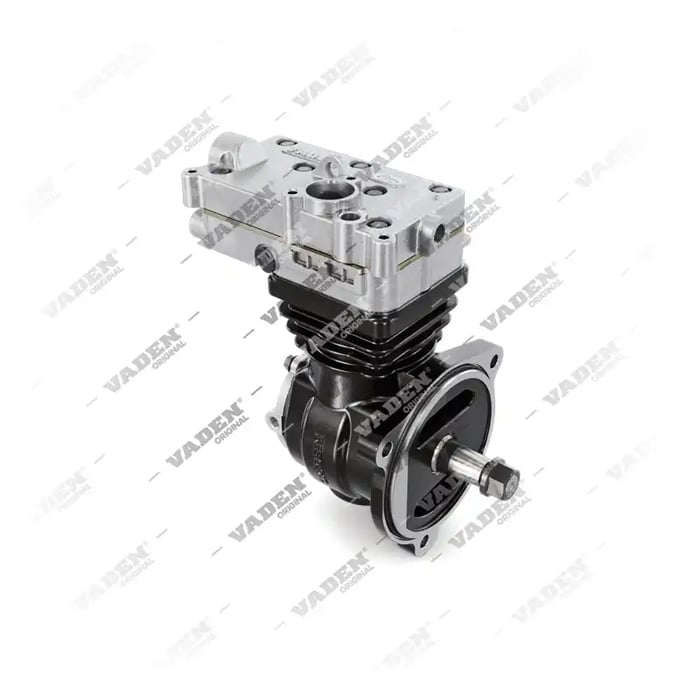
Need the part, not just the answer?
OE-grade air brake compressors and repair kits, manufactured and tested to commercial-vehicle standards.
Shop VADEN partsPublished by VADEN Original. Product links point to the manufacturer’s official catalogue. Specifications are general — always confirm figures against your vehicle’s service manual.