 airbrakecompressor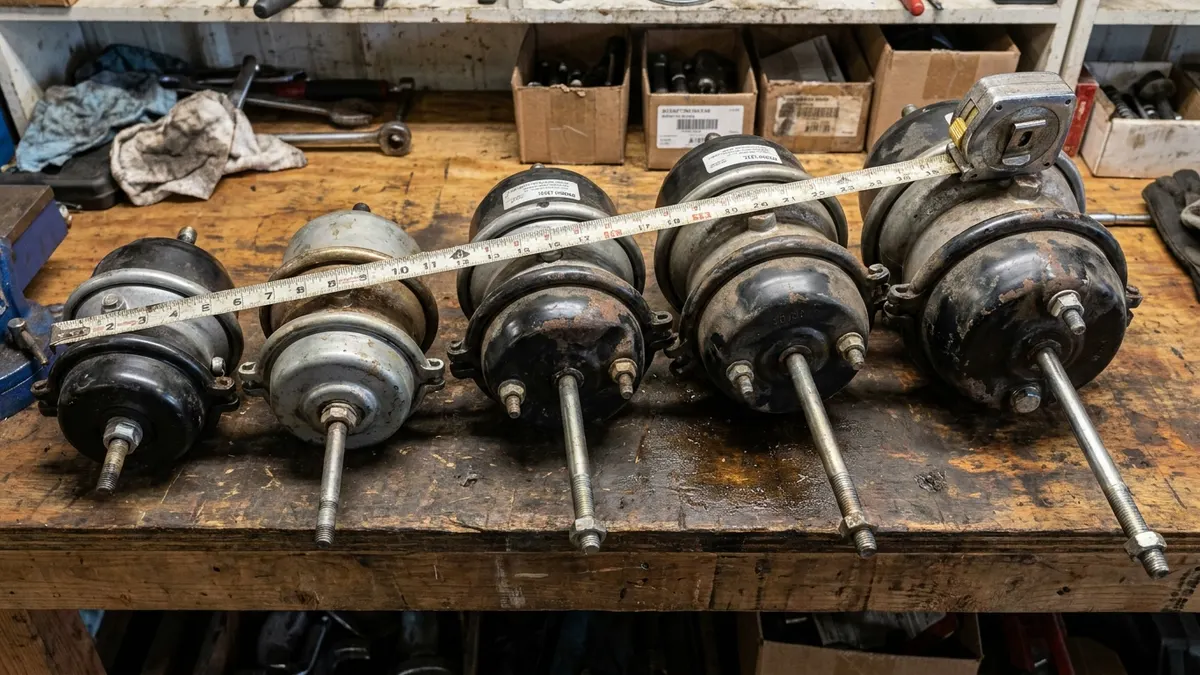
To cross-reference a brake chamber by OE number, treat the number as a lookup key, then verify five physical specs before you buy: chamber type (service-only or combination spring brake), size (effective area, such as Type 24 or Type 30), stroke (standard or long-stroke), port thread and orientation, and the mounting stud pattern. Two chambers with different manufacturer numbers cross to each other only when all five match. Because these are pneumatic components — air pressure pushing a diaphragm against a pushrod — a mismatch in area or stroke changes how much clamping force reaches the foundation brake, so the number alone is never enough.
Why the OE number is only the starting point
Truck builders, axle makers and brake suppliers each assign their own part numbers to what is often the same chamber, and one OE number can supersede through several revisions over a model's life. A cross-reference table lines those numbers up, but the catalog does not know whether your slack adjuster geometry, bracket, or port routing changed at a mid-year build. That is why a good cross always ends at the part itself. Pull the old chamber, read what is stamped or tagged on it, and confirm the replacement carries the same functional rating even if the casting looks slightly different. If you are new to these units, start with the basics of the brake chamber and how it converts air into mechanical force.
The five fields you must match
| Field | What it means | Why it matters |
|---|---|---|
| Type | Service only, or combination (service + spring parking) | The spring section applies your parking and emergency brakes; a service-only chamber has no park function |
| Size | Effective diaphragm area in square inches (Type 9-36) | Sets clamping force at a given air pressure; wrong size under- or over-brakes the axle |
| Stroke | Standard vs long-stroke rated travel | Determines usable adjustment range and pass/fail limits at inspection |
| Ports | Thread (commonly 3/8" NPT), count, and clocking | Wrong thread or angle will not seal or will foul the frame/lines |
| Mounting | Stud pattern, stud length, pushrod length and clevis | Must bolt to the existing bracket and reach the slack adjuster hole |
Size: what the number really is
Chamber size is written as a Type number — 9, 12, 16, 20, 24, 30 or 36 — and it equals the effective diaphragm area in square inches. It is not a diameter, a bolt spacing, or a stroke. A Type 30 applies more force than a Type 24 at the same air pressure simply because it has more area for the air to push on. When you cross by OE number, confirm the Type digit first; it is the single field most likely to be recorded wrong in a parts system. For a deeper breakdown, see brake chamber sizes explained.
Stroke: standard vs long-stroke
Two chambers can share the same Type number and stud pattern yet have different rated stroke. Long-stroke chambers give more pushrod travel before they run out of adjustment, and they have their own inspection limits at roadside checks. They are usually identified by squared or tagged port bosses and a stamped stroke marking. Do not substitute one for the other on a whim — a standard chamber fitted where a long-stroke belongs can pass adjustment when cold and fail hot. The differences and how to tell them apart are covered in standard vs long-stroke brake chamber.
Combination (spring brake) chambers
Parking-capable axles use a combination chamber written as service/spring, for example 24/24, 30/30 or 24/30. The first number is the service side that responds to the foot valve; the second is the spring side that holds the truck when air is exhausted. When you cross a combination number, match both halves. The power spring inside applies the parking brake as system pressure bleeds off — roughly 20-45 psi is where the spring starts to overcome the air holding it caged. That stored energy is why you never cut, torch, or disassemble a spring chamber; replace it as a sealed unit and cage it before removal.
A repeatable cross-reference procedure
- Read the old chamber: note any stamped Type, stroke, and the OE or supplier number on the tag or clamp band.
- Look the number up in a reputable cross-reference and write down the candidate replacement.
- Compare the five fields above against the candidate's published spec, not just its number.
- Measure what the catalog cannot see: stud length, pushrod length, clevis type and port angle on the truck.
- Confirm the service side commands the same slack adjuster and the spring side matches the park circuit.
- Install, then run the wheel through a full stroke check and a parking-brake apply-and-release before it goes back in service.
A quick reference tag lookup will not tell you whether the pushrod reaches the slack adjuster clevis correctly, so keep a tape measure in the loop. If the pushrod ends up too short or too long, adjustment and released clearance both suffer — that clearance is what the chamber and slack adjuster work through every stop.
Where crosses go wrong
The common failures are all avoidable. Ordering by size alone and getting a standard chamber for a long-stroke position; crossing only the service half of a combination number and receiving the wrong spring rating; ignoring port clocking so the air line has to be forced into a bend; and reusing a clevis or pushrod length that no longer matches. Photograph the old unit from three angles, keep the tag, and match the physical part. A brake chamber that is the wrong Type, stroke, or spring rating will still bolt up and hold air — it simply will not brake the way the axle was engineered to, and that is exactly what an out-of-service inspection is looking for.
Need the part, not just the answer?
OE-grade air brake compressors and repair kits, manufactured and tested to commercial-vehicle standards.
Shop VADEN partsPublished by VADEN Original. Product links point to the manufacturer’s official catalogue. Specifications are general — always confirm figures against your vehicle’s service manual.