 airbrakecompressor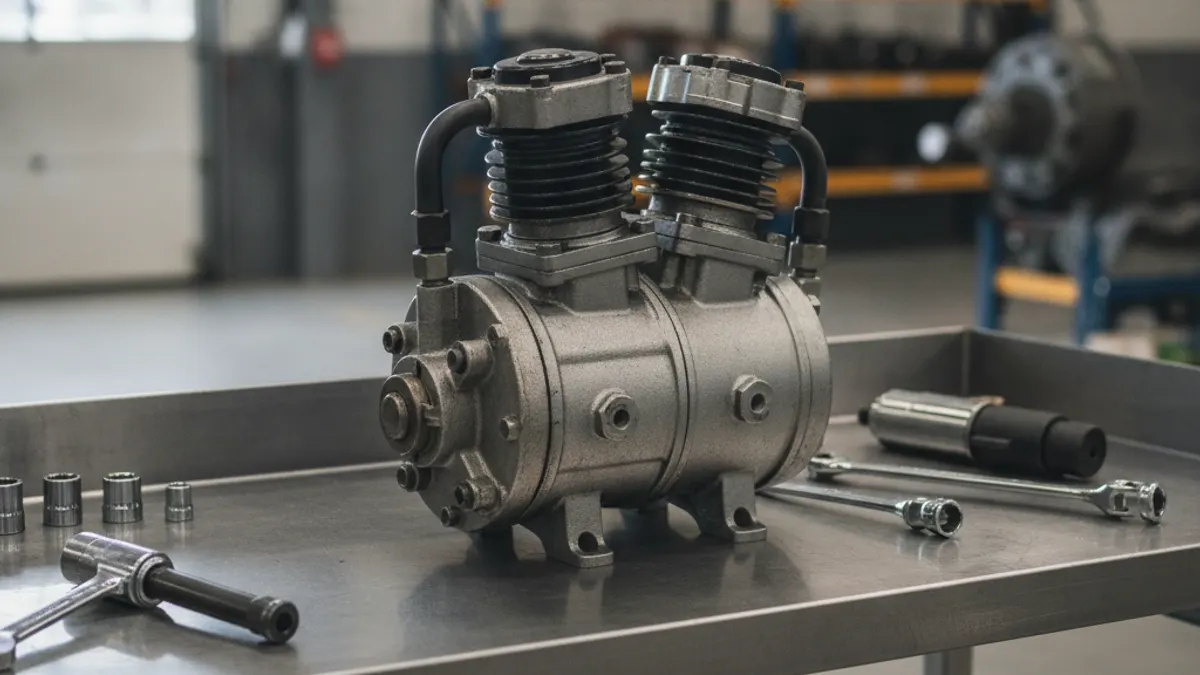
Almost every heavy-duty air brake compressor in service was built by one of three suppliers — Bendix, Wabco (now part of ZF) or Knorr-Bremse — even when it arrives in a Mercedes-Benz, Volvo, DAF, MAN, Scania, Cummins, Detroit or Paccar box. Cross-referencing works because these units are built in a handful of model families. It only gives you the right part, though, when the drive, mounting, displacement, cooling and port layout all match the compressor you pulled off. Treat any cross-reference table as a starting point, then verify the physical unit on the bench.
The major air brake compressor makes
The brand cast into the housing tells you which family of unloader hardware, gaskets and repair kits fits. It does not always tell you which number to order, because the same compressor is frequently sold under an engine or chassis maker's own part number.
| Maker | Common model families | Typically found on |
|---|---|---|
| Bendix | Tu-Flo single- and twin-cylinder families, BA-921/BA-922, DuraFlo | North American tractors and buses — Cummins, Detroit, Paccar, International, Mack and Volvo applications |
| Wabco / ZF | Single- and twin-cylinder units, commonly with 411-series numbering | European trucks and buses, plus North American engines built to Wabco spec |
| Knorr-Bremse | LK-series single- and twin-cylinder units | MAN, DAF, Scania, Volvo, Mercedes-Benz and bus or trailer applications in Europe |
| Truck or engine maker branded | Numbers issued by the chassis or engine builder | The same physical compressor, boxed and numbered by the OEM |
| OE-grade aftermarket | Supplier's own catalogue number, listed against the OE numbers it replaces | Replacement units built to the original spec and interfaces |
If you are not certain what you are looking at, start with the basics of how a truck air compressor is built and driven, then come back to the numbers.
Why cross-referencing is not just number matching
A part number encodes far more than a casting. Two units from the same family, with numbers one digit apart, can differ in drive type, head configuration or discharge position — and either will bolt up long enough to fool you before it causes a problem.
The number on the old compressor may not be the number you need
Compressors get remanufactured, and reman houses stamp or tag their own numbers over the original. Chassis builders re-number units for their own parts systems. And a compressor may have been superseded once or twice since the truck was built, so the casting number is genuinely obsolete. Wherever possible, work from the chassis VIN or engine serial number first, and use the number on the old unit only to confirm.
What actually has to match
| Feature | Why it matters |
|---|---|
| Drive type | Gear-driven, spline or coupling, or belt and pulley. Gear-driven units also differ in gear pitch and in whether the gear transfers from the old compressor. |
| Mounting flange and bolt pattern | Two-, three- and four-bolt and SAE flange patterns are not interchangeable. Adapter plates change gear mesh and are rarely acceptable. |
| Displacement and rated output | Undersizing gives slow recovery and a governor that rarely reaches cut-out. Oversizing loads the drive and pushes more heat and oil vapour downstream. |
| Cooling method | Air-cooled against water-cooled heads. A water-cooled unit needs its coolant ports plumbed; an air-cooled head fitted where a water-cooled one belongs will run hot. |
| Head and port orientation | Discharge, inlet, governor and unloader port positions decide whether the existing lines reach without re-routing. |
| Unloader and control style | Some families unload through the head, others through a separate valve, and the governor plumbing has to suit. See how the unloader valve works. |
| Oil feed and drain | Pressure-fed against self-lubricated, plus the drain-back path. Get this wrong and the compressor either starves or passes oil. |
| Inlet source | Naturally aspirated against engine-boosted inlet. Feeding a naturally aspirated head from a charged inlet is a fast route to carbon and oil carryover. |
A working cross-reference procedure
- Record the chassis and engine identity. VIN, engine serial and build date. This is the most reliable key into any catalogue.
- Read every number on the old unit. Casting number, data-plate number and any reman tag. Photograph the plate before it gets oily.
- Look up the OE number, then its supersession. Many original numbers have been replaced, and the current number is the one to cross-reference from.
- Match the physical features against the checklist above, using the old compressor on the bench as the reference sample.
- Confirm the accessories carry over. Gear, pulley, governor, coolant fittings and mounting hardware are often not supplied with the new unit.
- Verify after install. Check build-up time, then governor cut-out — typically in the region of 120–135 psi — and cut-in at roughly 100–110 psi. A fully charged system generally sits near 120 psi, the low-air warning should stay well clear of its trigger point around 60 psi, and leak-down with the engine off must remain inside the manufacturer's limit.
A compressor that fits mechanically but is wrong on displacement or cooling will pass a walk-around and then fail six months later as oil in the tanks, a saturated dryer, or a unit that never quite reaches cut-out. Cross-reference on function, not only on fit.
Genuine, remanufactured and OE-grade aftermarket
Genuine units come in the truck maker's box at the truck maker's price. Remanufactured units vary widely: the thorough ones replace the crank kit, bearings, rings and valve plate, but "reman" on its own is not a specification. OE-grade aftermarket sits between the two — newly manufactured to the original interfaces and output spec, and catalogued directly against the OE numbers it replaces. That is where most fleets land, and it is why a clear cross-reference matters more than the badge on the box. VADEN Original publishes its own OE cross-reference in its air brake compressor catalogue, listing each unit against the numbers it replaces.
Notes by make
Bendix. The Tu-Flo naming convention broadly reflects rated output, so the family name gives a quick sanity check on displacement. Single- and twin-cylinder variants exist within the same family, and head castings differ between air- and water-cooled versions.
Wabco / ZF. Since ZF absorbed Wabco, the same compressor may be documented under either brand. Numbering is generally long-form and application-specific, and European chassis catalogues usually give both the Wabco number and the chassis maker's number.
Knorr-Bremse. LK-series units cover a wide displacement range and appear on several European chassis with different mounting and drive arrangements. The LK number is the useful key, because the chassis number alone can hide meaningful differences.
When a cross-reference is the wrong answer
If the last compressor failed early, fitting its correctly cross-referenced twin will not address the cause. Repeated failures usually point to a restricted inlet, a saturated air dryer, an excessive duty cycle caused by system leakage, or oil carryover with a downstream cause. Sort the system first, then order the part. And if you are weighing output classes for a rebuild or an upgrade, read the trade-offs in single- against twin-cylinder compressors before you commit.
Source (VADEN Original): WABCO Cross Reference: VADEN Equivalent Part Numbers
Need the part, not just the answer?
OE-grade air brake compressors and repair kits, manufactured and tested to commercial-vehicle standards.
Shop VADEN partsPublished by VADEN Original. Product links point to the manufacturer’s official catalogue. Specifications are general — always confirm figures against your vehicle’s service manual.