 airbrakecompressor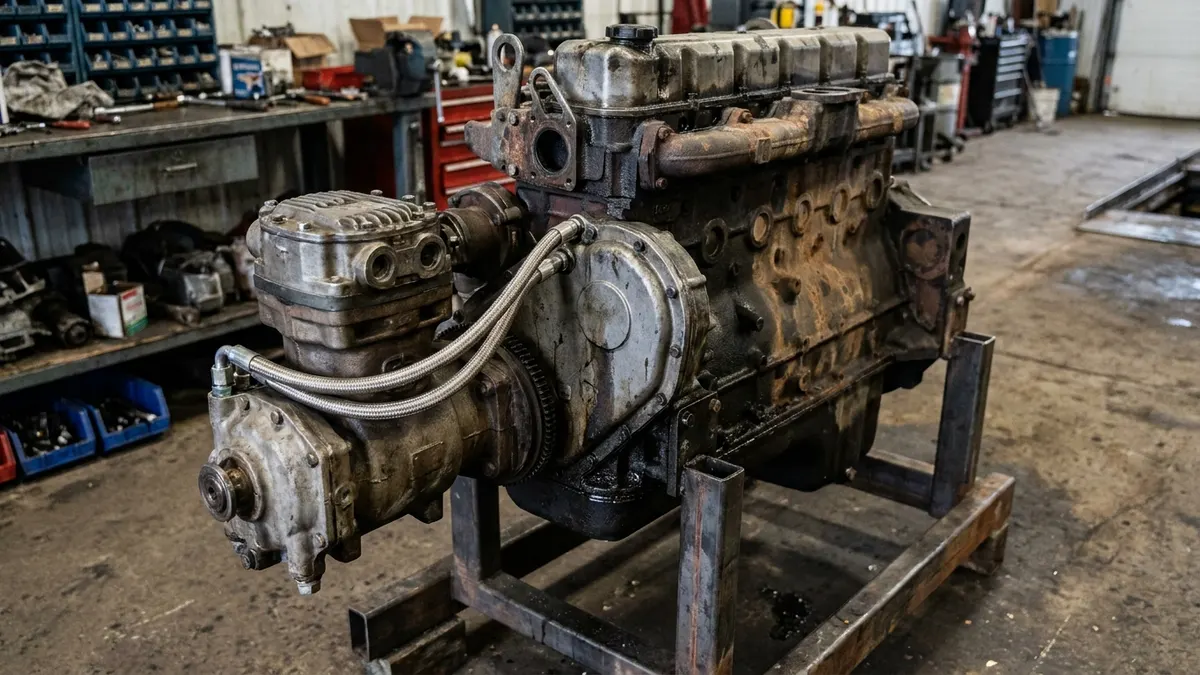
To find the correct air brake compressor for your engine, read the OE part number stamped on the compressor body or its riveted data plate, then cross-reference that number against a catalog for your engine platform — DD15, MX-13, X15, D13, or OM 471. The engine model narrows the field, but the stamped number is the real key, because year, emissions package, and drive type all shift the exact part.
Air brake compressors are engine-mounted, gear- or belt-driven pneumatic pumps — not the hydraulic pumps you'd find on a car. Because they hang off the engine's timing gears or accessory drive, each engine family runs a defined set of compressor part numbers. Get the cross-reference right and the unit bolts up, ports line up, and it builds air to spec.
Where the OE number lives
Before you cross-reference anything, find the original number. On most heavy-duty compressors it appears in one of three places:
- Cast or stamped into the crankcase — usually on a machined pad near the mounting flange.
- A riveted or bonded data tag — carries the manufacturer number (Bendix, Wabco, Knorr-Bremse) plus an assembly or "piece" number.
- The engine builder's parts number — Detroit, Cummins, PACCAR, Volvo/Mack, and Mercedes each assign their own number to the same compressor, so a unit can carry two valid references.
Record every number you can read. A single compressor may cross to a Bendix number, a Knorr-Bremse number, and an engine-maker number — any of them will pull the correct replacement. If the tag is unreadable, measure the mounting flange, count the cylinders, and note the drive type before you start guessing.
Cross-reference by engine platform
The table below shows how common engine families map to compressor characteristics. Treat it as a starting point — always verify against the stamped number, because a mid-cycle emissions change or an air-conditioning drive option can swap the part.
| Engine platform | Typical compressor supplier | Common config | Approx. displacement class |
|---|---|---|---|
| Detroit DD15 / DD13 | Wabco / Bendix | Single or twin cylinder | Medium to heavy duty |
| Cummins X15 / ISX15 | Bendix (Tu-Flo series) | Twin cylinder | Heavy duty |
| PACCAR MX-13 | Knorr-Bremse / Wabco | Twin cylinder | Heavy duty |
| Volvo D13 / Mack MP8 | Knorr-Bremse / Wabco | Single or twin cylinder | Medium to heavy duty |
| Mercedes-Benz OM 471 | Knorr-Bremse | Twin cylinder | Heavy duty |
Notice the pattern: North American engines (Cummins, Detroit) frequently run Bendix or Wabco units, while European platforms (Mercedes, PACCAR/DAF, Volvo) lean toward Knorr-Bremse and Wabco. That is a tendency, not a rule — verify the number. If you want the deeper supplier breakdown, see our guide to Bendix, Wabco, and Knorr-Bremse compressors.
Matching displacement to the duty
Two compressors can share a mounting flange yet move very different volumes of air. Displacement — expressed in cfm at governed engine speed — determines how fast the system recovers after brake applications and how well it keeps up with air-hungry accessories.
- Single-cylinder units move less air and suit lighter demand — straight trucks, buses with modest accessory loads, and tractors that rarely pull heavy trailer brake air.
- Twin-cylinder units move substantially more and are built for heavy trailer brakes, air suspension, air-operated PTOs, and dump-body service where the governor cycles often.
The rule is simple: replace like with like, or step up if the original was undersized for how the truck is actually used. Fitting a smaller compressor to save money causes constant cycling, slow build, and a low-air warning that lingers. Undersizing is one of the most common reasons a "correct-fitting" replacement still can't keep the system charged. For the trade-off in detail, read single vs. twin-cylinder air compressor.
Confirm the fit beyond the number
A matching part number gets you most of the way, but confirm these before you install:
- Mounting flange and bolt pattern — gear-driven units flange directly to the timing case; belt-driven units mount on a bracket.
- Drive type — gear, spline, or pulley; a gear-drive unit will not adapt to a belt bracket.
- Port locations and sizes — inlet, discharge, and coolant/oil connections must line up with your existing plumbing.
- Unloader style — verify the compressor works with your governor and unloader arrangement so it cuts out cleanly at governed pressure, typically around 120–135 psi, and reloads near 100–110 psi.
When the OE tag is gone entirely, cross-referencing by engine plus these physical checks will usually land you on the right unit. You can browse OE-grade replacements in VADEN's air brake compressor range, which lists units by engine application and OE reference.
OE vs. aftermarket references
Reputable aftermarket manufacturers publish cross-reference tables that map their part number back to the Bendix, Knorr-Bremse, Wabco, and engine-maker numbers. That is exactly what you want — a documented chain from your stamped number to the replacement. Be wary of a "universal" compressor sold only by generic dimensions; without an OE cross-reference you are trusting that the flange, displacement, and unloader all happen to match. For a deeper look at that decision, see OE vs. aftermarket air compressors. When in doubt, start from the number, confirm the duty, and check the four physical points above.
Need the part, not just the answer?
OE-grade air brake compressors and repair kits, manufactured and tested to commercial-vehicle standards.
Shop VADEN partsPublished by VADEN Original. Product links point to the manufacturer’s official catalogue. Specifications are general — always confirm figures against your vehicle’s service manual.