 airbrakecompressor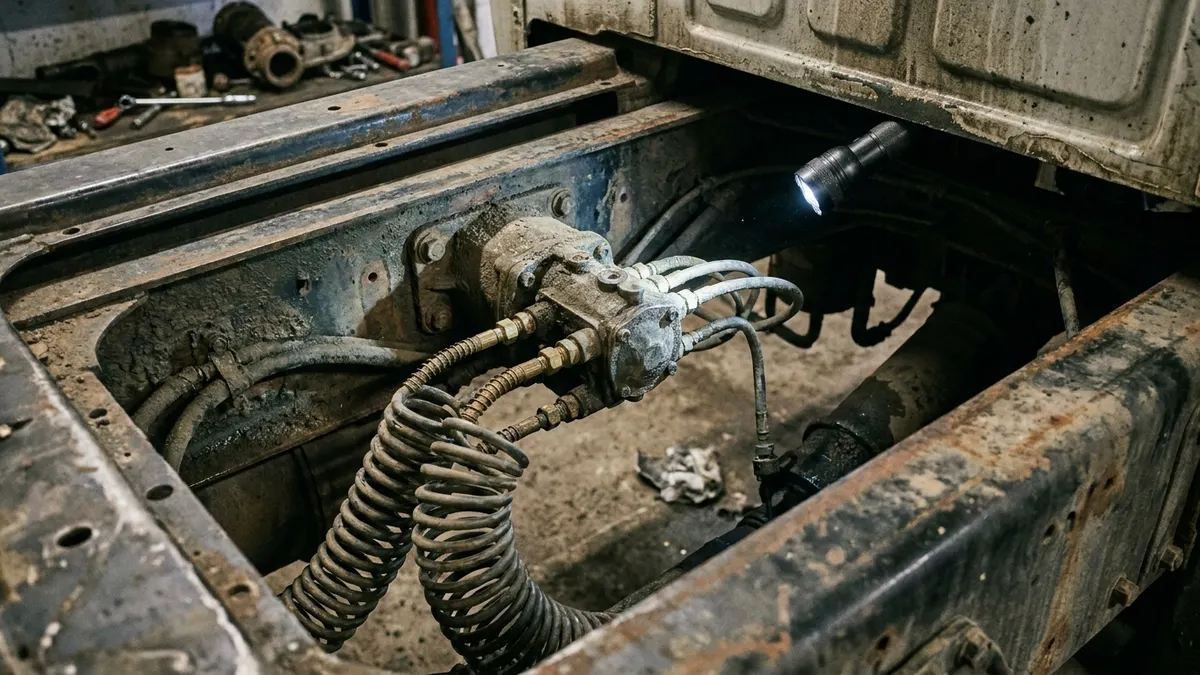
A brake treadle valve rebuild kit is a set of replacement soft parts — O-rings, inlet and exhaust valve assemblies, exhaust seats, springs, the rubber graduating spring and a mounting gasket — that restores sealing inside the foot brake valve without buying a whole new unit. You need one when the valve hisses at its exhaust port, bleeds down the system overnight, or is slow to release the brakes, and the valve body and bores are still clean. On most dual-circuit treadle valves a rebuild is a bench job of roughly an hour, because everything that actually wears is rubber and a couple of small seats.
What the treadle valve does
The treadle valve is the driver's metering valve for the service brakes. On a dual-circuit truck it is effectively two valves in one body: a primary section pushed directly by the pedal plunger through a rubber graduating spring, and a secondary section operated pneumatically by primary delivery pressure, with a mechanical backup if the primary circuit fails. Pressing the pedal closes each exhaust seat and opens each inlet valve, feeding reservoir air — around 120 psi on a fully charged system — down to the relay valves and brake chambers in proportion to pedal effort. Lift your foot and it reverses: the inlet closes, the exhaust opens, and chamber air dumps out through the exhaust port. Every one of those events seals on rubber, thousands of times a day. For how the valve meters and balances the two circuits, see our page on the foot brake valve.
What is in a treadle valve rebuild kit
Contents vary by valve family — Bendix E-6 style, Wabco/ZF, Knorr-Bremse, Haldex and Midland designs are not interchangeable — but a proper kit for a dual-circuit treadle valve normally includes:
- Primary and secondary inlet/exhaust valve assemblies
- Exhaust valve seats or seat inserts
- All piston and body O-rings, plus back-up rings where used
- The rubber graduating spring that gives the pedal its feel and graduation
- Return springs, retaining rings and snap rings
- Exhaust port diaphragm or cover
- Mounting gasket
- A sachet of rubber-safe silicone or barium-based lubricant
Some kits add the plunger, pedal roller and boot. Buy the kit by the valve's own part number stamped on the body, not by truck model — the same chassis is often built with two or three different treadle valves across a production run.
Symptoms that point to the treadle valve
Internal leakage in a treadle valve is one of the most common causes of a system that will not hold air overnight, and it is often blamed on the compressor first. Use the symptom to narrow down which seal has failed.
| Symptom | Usual internal cause | Covered by a rebuild kit? |
|---|---|---|
| Steady hiss at the exhaust port, pedal released | Primary or secondary inlet valve leaking past its seat | Yes |
| Hiss at the exhaust port only while the pedal is applied | Damaged exhaust seat or a bypassing piston O-ring | Yes |
| Leak from around the base or floor plate | Mounting gasket or body seal | Yes |
| Brakes slow to release, light drag after lifting off | Sticky plunger, swollen graduating spring or a blocked exhaust | Usually |
| Dead or spongy pedal feel, poor graduation, brake lag | Collapsed or hardened rubber graduating spring | Yes |
| One circuit delivers noticeably less than the other | Relay piston O-ring bypass — or a scored bore | Only if the bore is clean |
| Pitted, corroded or scored valve body | Years of wet, oily air from a failing dryer | No — replace the valve |
Prove it is the treadle valve first
Chock the wheels, build the system to governor cut-out (typically 120–135 psi), shut the engine down and watch the gauges. A released system that bleeds faster than the limits below has a leak somewhere; if the loss appears or worsens when you make and hold an application, the treadle valve moves to the top of the list. Listen at the exhaust port with the pedal up, then again with it held down — the difference tells you inlet side or exhaust side. Soap solution around the body and mounting flange finds the external leaks. Our guides on air brake systems losing pressure and finding an air leak fast cover the wider hunt.
| Leak-down test (one minute, engine off) | Single vehicle | Combination vehicle |
|---|---|---|
| Brakes released | 2 psi max | 3 psi max |
| Brakes applied and held near 90 psi | 3 psi max | 4 psi max |
Remember that a slow bleed will eventually drop you to the low-air warning, which sounds around 60 psi, and if it keeps falling the spring brakes will set themselves somewhere in the 20–45 psi range. That is a roadside event, not a shop event, so do not defer a confirmed treadle leak.
Rebuild or replace?
Rebuild when the body is clean, the bores are smooth, the valve is a current design and the kit is available. Replace when you find scoring, corrosion pitting, a seized plunger bore, cracked castings, damaged port threads, or when the valve has already been rebuilt once and is leaking again — that usually means the bore finish is gone. Also weigh the labour: on a firewall-mounted valve with a remote pedal linkage, the removal time dwarfs the parts cost either way, so many fleets simply fit a new valve and rebuild the old one as a shelf spare.
Rebuild notes that save comebacks
- Drain the system fully and disconnect power before removing the valve. Tag every line — primary, secondary, and any stop-lamp or pressure switch port.
- Work clean. A single grit particle on an exhaust seat will hiss forever.
- Lay parts out in order as you strip. Primary and secondary components look similar but are not always identical.
- Inspect bores under good light. Any visible score line means the valve is scrap.
- Lubricate the new O-rings and seats only with the grease supplied. Petroleum grease swells and destroys the rubber within weeks.
- Fit the graduating spring the correct way round and do not stretch it.
- Torque the mounting bolts and cover screws to the OE figure; overtightening distorts the exhaust cover and causes a leak that looks like a bad valve.
Verify before the truck rolls
Refit, charge to cut-out, then repeat the released and applied leak-down tests above. Check that the pedal returns fully and freely, that both circuits deliver together, and that the brakes release promptly with no drag at the drums. Finally, fix the reason the seals died: a treadle valve that fills with oil and water has an air dryer or compressor problem behind it, and a fresh rebuild kit will not survive that for long.
A kit only helps while the bore and exhaust seat are still true. Where the body is scored or the seat pitted, fit one of the complete replacement foot brake valves rather than chasing the same leak twice.
Need the part, not just the answer?
OE-grade air brake compressors and repair kits, manufactured and tested to commercial-vehicle standards.
Shop VADEN partsPublished by VADEN Original. Product links point to the manufacturer’s official catalogue. Specifications are general — always confirm figures against your vehicle’s service manual.