 airbrakecompressor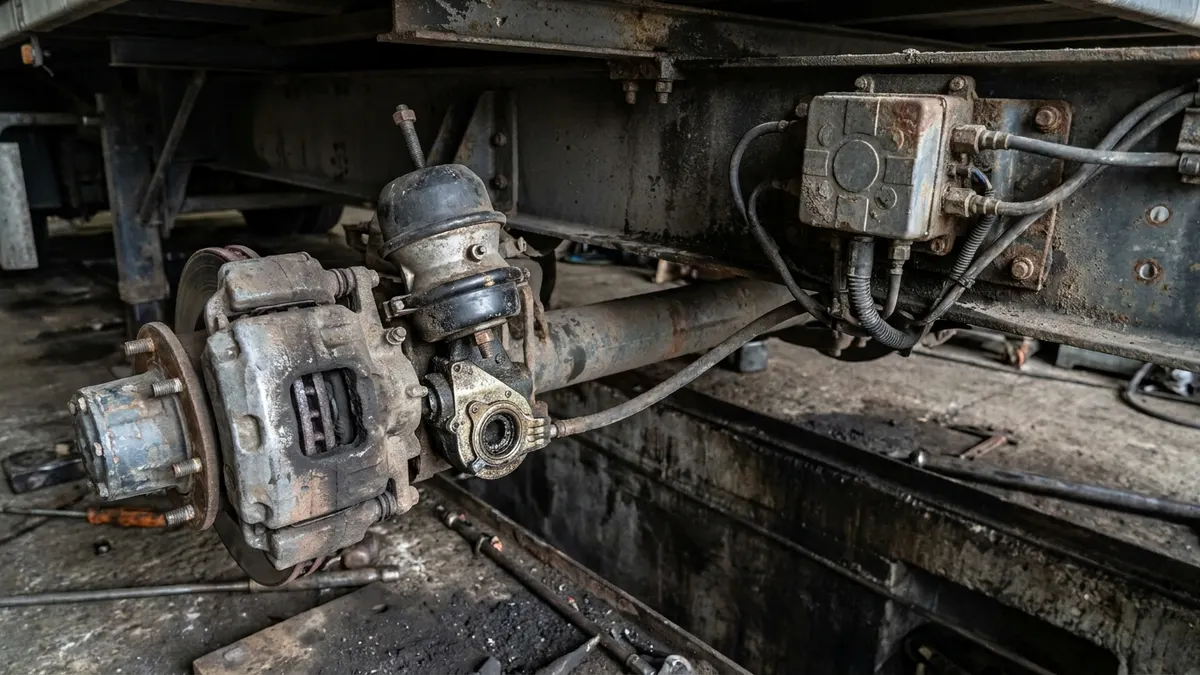
Midland air brake valves are the pneumatic control valves — relay, quick-release, spring brake and anti-compounding, tractor protection, dash control, check and pressure protection valves — originally built by Midland Brake and now catalogued under Haldex, which took over the Midland line in the late 1990s. On a vehicle you identify one by the raised casting number on the body plus the stamped or tagged service number, and you cross-reference it by function and plumbing rather than by the casting alone. Most Midland valves interchange functionally with the equivalent Bendix, Wabco/ZF or Knorr-Bremse part, but port layout, thread type and mounting pattern decide whether it is genuinely a bolt-on swap.
Who builds Midland valves today
Midland Brake grew out of the old Midland-Ross heavy-duty business in North America, while a parallel European operation traded as Midland-Grau. Both were folded into Haldex at the end of the 1990s, which is why a valve stamped Midland, a Midland-Grau casting on a European chassis, and a current Haldex service box can all end up describing the same component. Fleet parts systems have not caught up evenly: plenty of shop inventories still list legacy Midland numbers that have been superseded once or twice since. If a Midland number returns nothing at the counter, search the current Haldex air brake parts catalogue for the superseding number before assuming the part is obsolete.
What the Midland range covers
The line spans most of the control side of a heavy vehicle air system — everything between the reservoirs and the brake chambers, plus the supply-side hardware. The table below summarises the families you are most likely to pull off a tractor, trailer or coach.
| Valve family | What it does | Working notes |
|---|---|---|
| Relay valve | Uses the foot valve signal as a control input and delivers air to the rear or trailer chambers from a nearby reservoir | Crack pressure typically around 4 psi; higher-crack versions in the 8-10 psi range exist to tune application timing |
| Quick-release valve | Exhausts chamber air locally on release instead of routing it back to the foot valve | Fitted close to the chambers; a common cause of slow release when the diaphragm hardens |
| Spring brake / anti-compounding valve | Controls the parking side of the spring brake chamber and prevents service and spring force adding together | Spring brakes hold off at full system pressure and begin to apply as pressure falls into the 20-45 psi band |
| Tractor protection valve | Isolates the tractor supply if the trailer supply line is broken or drained | Required to close automatically somewhere between 20 and 45 psi |
| Dash control valves | Push-pull controls for trailer supply and parking, with automatic pop-out on pressure loss | Pop-out occurs in the same 20-45 psi region as spring brake application |
| Pressure protection valve | Blocks auxiliary circuits (suspension, PTO, accessories) until the brake circuits are charged | Commonly set to open once system pressure is well established, in the 60-80 psi region |
| Check valves | Hold air in a reservoir or circuit when upstream pressure drops | Single and double-check types; a leaking one shows up as overnight pressure loss |
| Governor | Signals the compressor unloader to stop and resume pumping | Cut-out typically 120-135 psi, cut-in typically 100-110 psi |
If you are still working out which valve is which on an unfamiliar chassis, the broader breakdown of air brake valve types is a faster route than tracing every line by hand.
Identifying a Midland valve on the vehicle
Casting number versus service number
Every Midland valve body carries a raised casting number moulded into the aluminium. That number identifies the mould, not the finished assembly — the same casting is often used across several service parts with different internals, springs or crack pressures. The number you order against is the stamped or ink-marked service number, usually on a machined flat, a boss near the mounting face, or a foil tag under the bracket. On a valve that has lived under road salt for a decade, expect to clean the flat with a brass brush before anything is legible.
If the only number you can read is the casting, treat it as a shortlist, not an answer. Confirm the service number by function, port count and crack pressure before ordering.
Port markings tell you the circuit
North American Midland valves normally use word markings cast next to each port: SUP for supply, DEL or SERV for delivery, CONT for the control signal, and EXH for exhaust. European-heritage castings follow the numbered convention — 1 for supply, 2 for delivery, 3 for exhaust, 4 for control. Mixing the two conventions up is the single most common way a correct part gets plumbed wrong. Photograph the valve with the lines still attached before you break anything loose.
Cross-referencing a Midland valve
Functional equivalents across OE brands are common, and swapping a Midland relay for a Bendix, Wabco/ZF or Knorr-Bremse unit is routine work — provided five things line up:
- Function and port count. A two-port quick-release valve and a three-port relay valve are not alternatives for one another.
- Port thread type and size. North American valves are generally NPT; European-heritage valves use metric straight threads sealed with an O-ring. These do not mix.
- Mounting pattern. Bolt centres, stud size and whether the valve is reservoir-mounted or bracket-mounted.
- Crack pressure. Fitting a standard relay where a higher-crack version was specified changes when that axle starts to work, and can make the vehicle lead or lag on application.
- Flow capacity. An undersized valve on a long chamber run shows up as brake lag, not as an obvious fault.
The same discipline applies in reverse. If a chassis has already been repaired once with whatever was on the shelf, do not assume the fitted valve is what the builder specified — check it against the vehicle's own air system schematic. Our detailed page on the relay valve covers the timing side of that decision in more depth.
Where these valves sit in the pressure picture
None of this hardware works properly on a sick supply side. A healthy system charges to roughly 120 psi, with the governor cutting out somewhere in the 120-135 psi band and cutting back in around 100-110 psi. The low-air warning light and buzzer come on at about 60 psi, and the spring brakes begin to apply as pressure falls into the 20-45 psi range. Diagnosing a suspect valve before confirming those numbers wastes parts: a relay valve that appears slow is often a compressor, governor or air dryer problem showing up downstream. Always verify build-up time and leak-down rate first, then condemn the valve.
Rebuild, reman or replace
Service kits exist for most of the range, and rebuilding a valve is sensible when the bore is clean and the failure is a hardened diaphragm, a tired spring or a swollen O-ring. It is not sensible when the bore is pitted, scored, or has been running with oil-carrying air from a failing compressor — a kit will seal against corrosion for a few weeks at best. Where a Midland service number has been superseded and lead times are long, an OE-grade replacement is the practical route; VADEN's own relay valve range for commercial vehicles is one source of current-production units built to OE dimensional and performance standards. Whatever you fit, replace the valve and the cause together: if the air coming into it carried oil or moisture, the new valve inherits the same fate.
Need the part, not just the answer?
OE-grade air brake compressors and repair kits, manufactured and tested to commercial-vehicle standards.
Shop VADEN partsPublished by VADEN Original. Product links point to the manufacturer’s official catalogue. Specifications are general — always confirm figures against your vehicle’s service manual.