 airbrakecompressor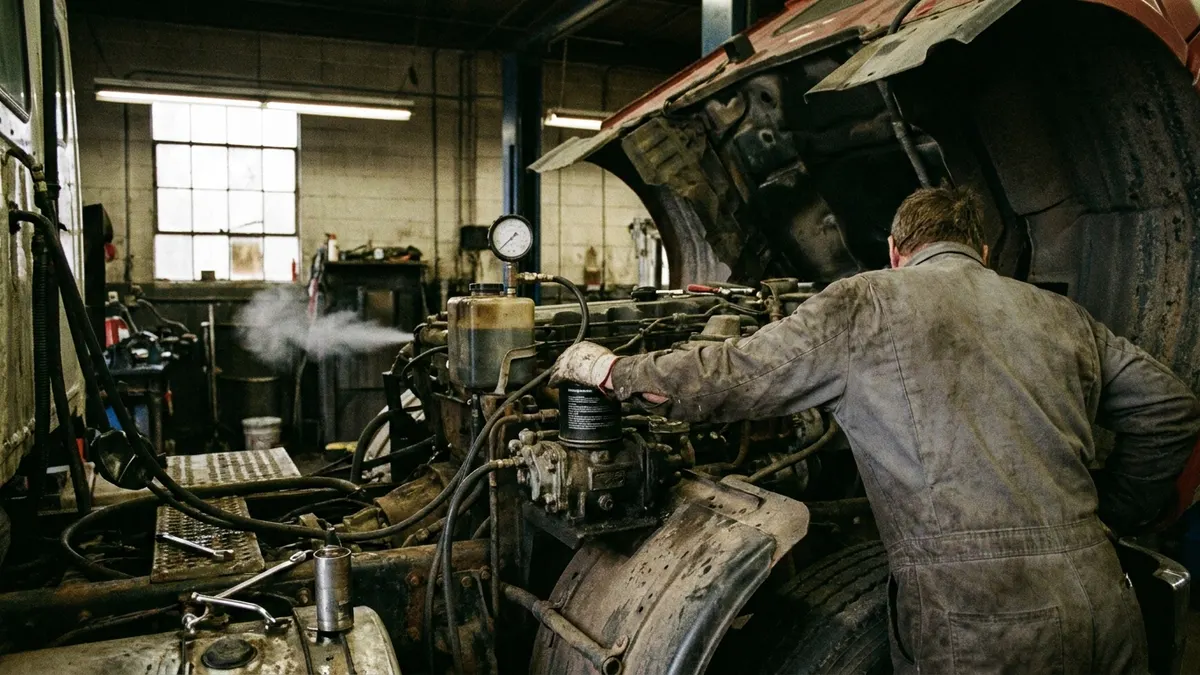
The air governor controls when the compressor delivers air by watching pressure in the supply (wet) tank: it cuts the compressor out—stops it building—at the high setting, typically about 120–135 psi, and cuts it back in at the low setting, roughly 100–110 psi. On most highway trucks that works out to near a 100/125 psi cycle with a 20–25 psi differential between the two points. When those settings drift you get short cycling, a compressor that never shuts off, or a system that will not reach full pressure.
What the governor actually does
The governor is a small pneumatic pilot valve, usually mounted on the compressor or on the firewall nearby and plumbed to the supply reservoir. It does not switch the compressor's rotation on and off—the compressor is belt- or gear-driven and keeps turning whenever the engine runs. Instead, the governor decides whether that spinning compressor is loaded (actually packing air into the tanks) or unloaded (turning freely and shuttling air back and forth without building pressure). It makes that call by sensing tank pressure and either sending or venting a control signal to the compressor's unloader mechanism.
Cut-out pressure: the high setting
When supply-tank pressure climbs to the cut-out point—commonly around 125 psi, within a 120–135 psi range depending on the vehicle—the governor opens an internal passage and routes air pressure to the compressor's unloader valve. That signal lifts the intake (unloader) plungers off their seats and holds the compressor's intake valves open. With the intakes propped open the piston just shuttles the same air back and forth instead of forcing it down the discharge line, so the compressor is now "unloaded" and stops raising system pressure. On air-dryer-equipped trucks the same governor signal usually triggers the dryer's purge, blowing accumulated water and oil out of the desiccant.
Cut-in pressure: the low setting
As you make brake applications, run air accessories, and lose a little to normal leakage, tank pressure falls. When it reaches the cut-in point—about 100–110 psi—the governor exhausts the control signal it was holding on the unloaders. The plungers seat, the intake valves close on the compression stroke again, and the compressor loads back up and resumes building. This governed band, cut-in to cut-out, is what keeps a healthy truck sitting near its fully-charged pressure without the compressor working every second.
Typical governor setpoints
| Setpoint | Typical range | What it means |
|---|---|---|
| Cut-out (high) | 120–135 psi | Governor unloads the compressor; building stops |
| Cut-in (low) | 100–110 psi | Governor loads the compressor; building resumes |
| Differential | 20–25 psi | The gap between cut-in and cut-out |
| Fully charged | about 120 psi | Top of the normal operating band |
| Low-air warning | about 60 psi | Buzzer and light; pressure is unsafe below this |
Treat these as typical field ranges. The exact cut-in and cut-out figures for your truck are set by the vehicle and component manufacturer—always confirm against the current service manual before you judge a governor good or bad.
Why the differential matters
The gap between cut-in and cut-out—the differential—is normally about 20–25 psi, and it exists on purpose. A healthy spread lets the compressor rest for a stretch after each build instead of loading and unloading constantly. If the differential shrinks so the two points sit only a few psi apart, the compressor short cycles: it loads and unloads every few seconds, which overheats the pump, floods the air dryer, and wears both out early. Too wide a spread and pressure sags noticeably between cycles, and the low-air warning may nuisance-trip.
What happens when the settings drift
Governor springs fatigue, seats wear, and the small internal ports gum up with oil carryover, so cut-in and cut-out can wander away from spec. Because the governor sits upstream of the unloader, a fault here often mimics a bad compressor—so read the symptom before you condemn the pump.
| Symptom | Likely governor-related cause |
|---|---|
| Compressor builds constantly, never cuts out | Cut-out set too high, governor stuck loaded, unloader not opening, or a leak outpacing the pump |
| Short cycling every few seconds | Differential too small, failing governor, or a reservoir leak |
| Won't reach normal pressure | Cut-out too low, weak compressor, or the governor unloading early |
| Pressure climbs too high, safety valve pops | Governor not reaching or holding cut-out; stuck unloaders |
| Air dryer purges too often or never | Governor purge-signal timing off |
Checking and adjusting the governor
Verify the setpoints with an accurate dash gauge or a known-good test gauge: run the engine and watch pressure build to where the compressor cuts out, then fan the brakes down and note where it cuts back in. Compare both against the OEM spec. Many governors carry an adjusting screw or collar, but nudging cut-out shifts the behavior of the whole air system, and a unit that is gummed, leaking, or worn is usually better replaced than nursed along. If your diagnosis points past the governor to the pump itself—worn rings, an unloader that will not seat, or a compressor that simply cannot reach cut-out—fit a quality replacement; VADEN's OE-grade air brake compressors are built to load and unload cleanly on the governor's signal. If the fault is clearly in the pilot valve itself, replace the air brake governor rather than over-adjusting it. Never open the air system without draining pressure first and following the manufacturer's procedure.
Need the part, not just the answer?
OE-grade air brake compressors and repair kits, manufactured and tested to commercial-vehicle standards.
Shop VADEN partsPublished by VADEN Original. Product links point to the manufacturer’s official catalogue. Specifications are general — always confirm figures against your vehicle’s service manual.