 airbrakecompressor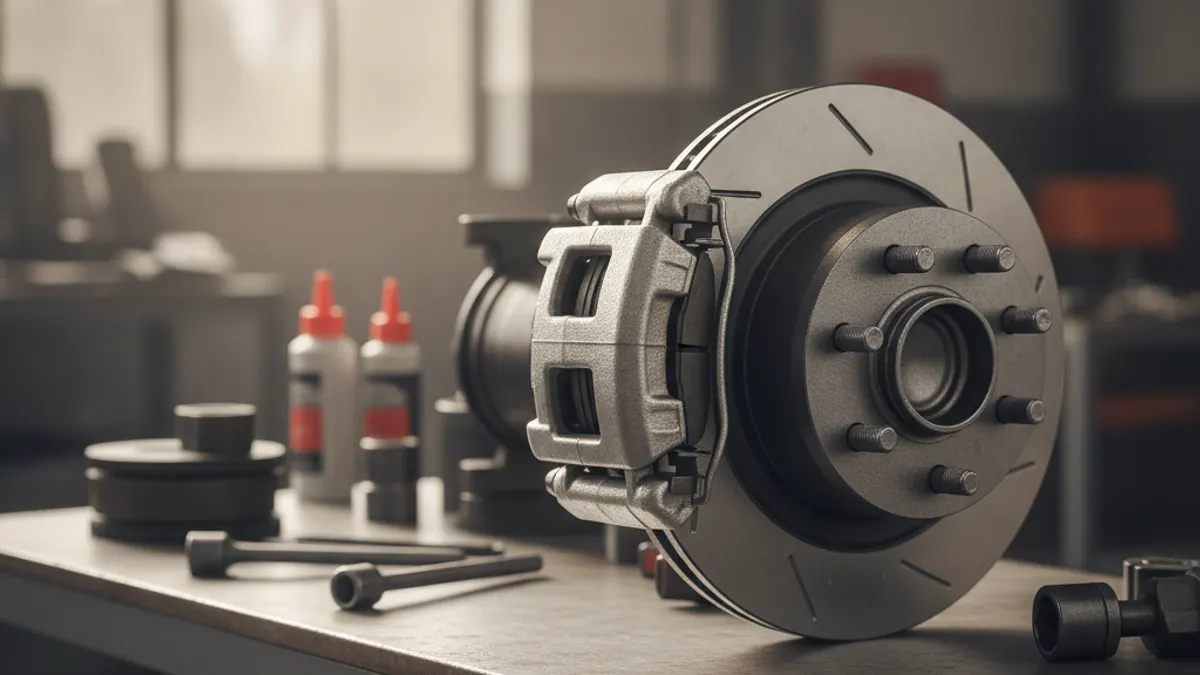
A truck brake caliper on an air disc brake (ADB) axle is a pneumatically actuated, mechanically amplified clamp. There is no brake fluid and no hydraulic piston. The service brake chamber bolted to the back of the caliper pushes a rod into the housing; that rod swings an internal lever riding on an eccentric bearing, which multiplies the input force many times over and drives one or two threaded tappets forward. The tappets push the inboard pad into the rotor, reaction force slides the whole caliper on its guide pins, and the outboard pad is pulled in from the other side. Everything else in the caliper — the automatic adjuster, the boots, the caps — exists to keep that action clean and to hold running clearance constant as the friction material wears.
If you already know drum brakes, the mental shift is this: the S-cam and slack adjuster live outside the foundation brake, where you can see and grease them. In an air disc caliper the equivalent hardware — the lever, the amplification, the automatic adjuster — is sealed inside the housing. That is why calipers are so reliable while the seals hold, and why they die quickly when the seals do not.
What is inside an air disc brake caliper
| Component | Function | Field serviceable? |
|---|---|---|
| Operating lever and eccentric bearing | Converts chamber pushrod travel into high clamp force | No — sealed, replace caliper |
| Tappets (thrust screws) | Transmit force to the inboard pad; thread out as pads wear | Partly — boots and caps in most kits |
| Automatic wear adjuster | Senses excess lever travel and extends the tappets to restore clearance | Yes on many designs, via adjuster kit |
| Guide pins and slide bushings | Let the caliper float so both pads share load evenly | Yes — the most common repair |
| Boots, caps and seals | Keep water, salt and grit out of pins, tappets and adjuster | Yes — cheap, replace on sight |
| Carrier (anchor bracket) and pad retainer | Locates the pads and takes braking torque into the axle | Retainer and springs yes; carrier wear means replacement |
| Pad wear sensor (where fitted) | Sends a dash warning as friction material approaches its limit | Yes |
Note what is not in that list: a parking mechanism. The caliper is clamped for parking by the spring brake section of the chamber, which applies mechanically as air is released — generally in the 20 to 45 psi window — so a disc-braked tractor parks exactly the way a drum-braked one does. The supply side is unchanged too: a fully charged system sits around 120 psi, the governor cuts out somewhere around 120 to 135 psi and cuts back in around 100 to 110 psi, with the low-air warning near 60 psi. For the actuator side of the wheel-end, see our brake chamber guide.
Running clearance and automatic adjustment
An air disc caliper holds a very small running clearance — well under a millimetre per side on most designs, which is a large part of why disc brakes respond faster than drums. The adjuster works off lever travel: if the lever has to swing further than its designed stroke before the pads make contact, the adjuster indexes the tappets out slightly on each application until travel is back in specification. Use the axle or caliper manufacturer's current service data for the exact clearance figure and measuring method; one number does not cover every family.
A quick function check most shops use: with the wheel-end secured, wind the adjuster back slightly with the correct adapter (never a random socket on the exposed hex), then make several low-pressure brake applications and watch the adjuster hex rotate a small amount each time. If it does not index, the adjuster has failed or the tappets are seized. A caliper that never adjusts gives a long, soft application and poor balance against the other wheel-ends.
The failures that actually happen
Guide pin seizure
This is the headline failure. Water gets past a split boot, the pin corrodes or the grease turns to paste, and the caliper stops sliding. The inboard pad keeps working and wears fast; the outboard pad barely touches and stays thick. That mismatch is the most useful diagnostic you have — pull the wheel, measure both pads, and if inboard and outboard differ noticeably, the caliper is not floating. Left alone it becomes a partially applied brake, which cooks the rotor, blues the pad edges and can pull the vehicle to one side.
Boot and cap damage
Torn tappet boots let moisture reach the threaded spindles. Once those threads corrode the adjuster can no longer extend them, so the caliper stops compensating for pad wear. A missing adjuster cap does the same damage from the other end. Boots cost little and are inspected at every pad change for exactly this reason.
Caliper will not retract
Dragging after release is usually a seized slide, a corroded tappet, or a chamber return spring that has lost tension — but rule out the air side first. A relay valve that holds pressure, or a crimped hose, will drag every brake it feeds rather than one. Our page on brakes that will not release walks the split between mechanical and pneumatic causes.
Rotor damage taking the caliper with it
Fine heat checking is normal; cracks running through to the vent or the outer edge are not. Fitting pads against a rotor that is past minimum thickness or badly scored throws the new set away in short order and loads the caliper hardware.
Symptom-to-cause quick table
| Symptom | Most likely cause | First check |
|---|---|---|
| Inboard pad worn, outboard nearly new | Seized guide pins | Push or pry the caliper by hand for free slide travel |
| Tapered pad wear front to rear | One pin binding, or worn carrier abutments | Measure the pad at both ends; inspect the carrier |
| Long, lazy response on one wheel | Adjuster not indexing | Adjuster function test; tappet condition |
| Hot wheel-end or burning smell after a run | Caliper not retracting, or air held at the chamber | Compare wheel temperatures; check release at the chamber |
| Pad wear lamp on, pads still thick | Chafed sensor wire or damaged sensor | Inspect the harness at the caliper |
| Rattle or knock over bumps | Worn pad retainer, spring or loose hardware | Retainer and pad spring condition |
Service or replace?
Service the caliper when the damage sits outside the pressure envelope: guide pins, bushings, boots, caps, pad retainer and springs, mounting hardware, and on many designs the adjuster mechanism. These are supported by manufacturer repair kits and are routine bench work.
Replace the caliper when the lever or eccentric bearing is damaged, when the housing bore or tappet threads are corroded, when the unit has been heat-damaged in a dragging event, or when a tappet will not wind freely in and out after cleaning. Guessing here is expensive: a caliper that binds again destroys a fresh set of pads and a rotor with it.
Always fit new caliper-to-carrier and carrier-to-axle bolts of the specified grade. Most are torque-plus-angle and are not designed to be reused. Follow the vehicle manufacturer's current service manual for the tightening figure and sequence.
Work in axle sets so braking stays balanced, bed the pads in with a series of moderate stops rather than one hard one, and re-check pad thickness and slide freedom at the next PM. If you are sourcing replacement units, VADEN Original supplies air disc brake calipers for heavy commercial vehicles alongside its compressor and air-system range.
Whether an ADB axle is the right specification in the first place is a separate question — weight, service intervals and parts availability all play in. Our comparison of air disc versus drum brakes covers that trade-off.
Need the part, not just the answer?
OE-grade air brake compressors and repair kits, manufactured and tested to commercial-vehicle standards.
Shop VADEN partsPublished by VADEN Original. Product links point to the manufacturer’s official catalogue. Specifications are general — always confirm figures against your vehicle’s service manual.