 airbrakecompressor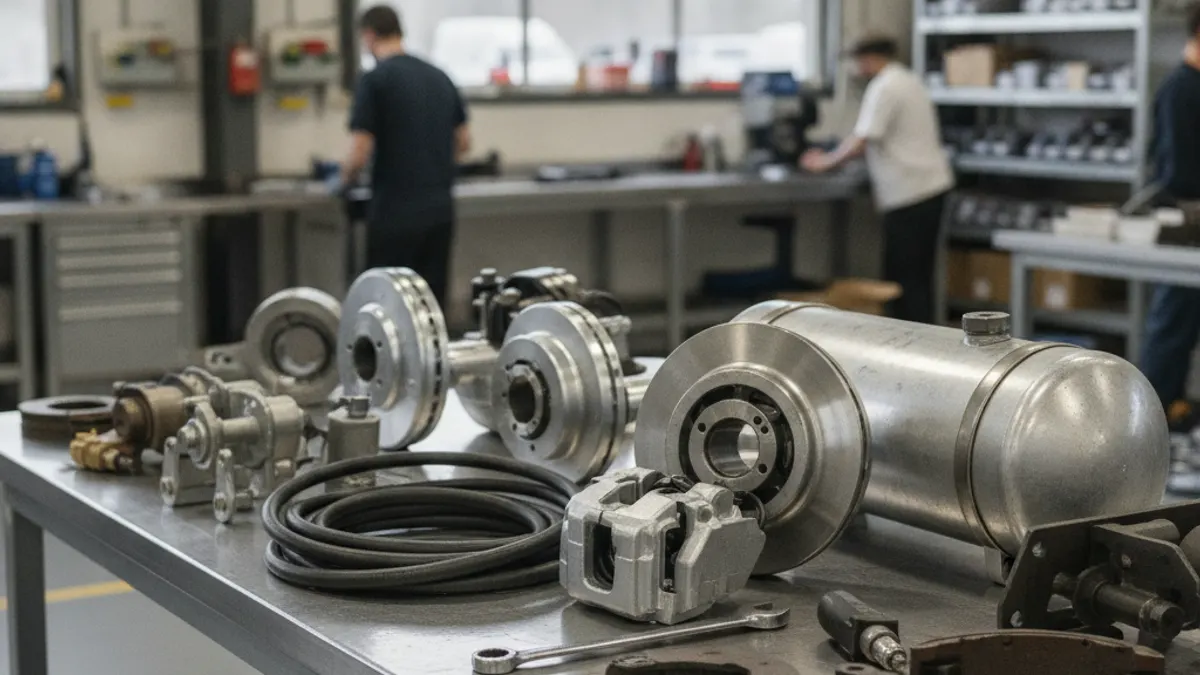
Every heavy truck sold in North America — Freightliner, Volvo, Peterbilt, Kenworth, Mack, International, Western Star — uses the same fundamental air brake architecture: an engine-driven piston compressor, a governor, an air dryer, a supply tank feeding two independent service circuits, and spring brakes for parking and emergency. These are pneumatic systems: braking force is carried by compressed air, not by hydraulic fluid. Operating pressures are effectively identical across makes because federal brake regulation sets them. What changes from one make to the next is the hardware package — which compressor the engine takes, where the dryer and valves are mounted, which foundation brake supplier the plant used, and how the dash and datalink are arranged.
That distinction matters most when you order parts. A search for "air compressor for a Kenworth" usually returns nothing useful, because the compressor belongs to the engine, not to the badge on the hood.
What every truck make shares
Regardless of badge, a modern tractor gives you the same functional chain. Air is drawn through an intake, usually off the engine air cleaner, and compressed by the engine-mounted compressor. It leaves hot through a discharge line to the air dryer, where it is dried and purged, then it is stored in the supply (wet) tank. From there it splits into primary and secondary reservoirs, so a failure on one circuit still leaves stopping power on the other.
- Governor cut-out: roughly 120-135 psi on all makes; cut-in typically 100-110 psi.
- Normal working range: a fully charged system sits around 120 psi.
- Low-air warning: buzzer and light around 60 psi.
- Spring brake application: parking brakes begin to drag and then set somewhere in the 20-45 psi band as air bleeds down.
- Foundation brakes: S-cam drum brakes are still the volume standard, with air disc brakes increasingly specified on steer axles and some drive axles.
- Couplings: standard gladhands, service (blue) and emergency (red), so any tractor can pull any properly equipped trailer.
Because of that commonality, diagnostic logic is portable. Slow build-up, an air governor that will not cut out, or oil passing the compressor rings behaves the same on a Volvo as it does on a Peterbilt.
What actually differs between makes
The compressor follows the engine
The compressor is bolted to and driven by the engine — gear-driven off the timing gear train on most heavy-duty diesels — so the correct unit is set by engine family, displacement and mounting flange, not by the nameplate on the hood. A Cummins X15 in an International and a Cummins X15 in a Kenworth call up closely related compressor part numbers. Conversely, a Freightliner with a Detroit DD15 and a Freightliner with a Cummins take entirely different compressors. See air compressors for Cummins engines for how that plays out within one engine family.
Air treatment packaging
Dryer brand, mounting location and purge arrangement are chassis-engineering decisions, so they vary by make and even by spec within a make. Some chassis hang the dryer high on the frame rail behind the cab; others tuck it low ahead of the drive axles, where it collects more road spray and corrodes faster. Cartridge service intervals, and whether the truck has an integrated purge volume or a separate purge tank, follow the same pattern.
Foundation brakes, adjusters and valves
Chamber sizes, slack adjuster brands and relay valve locations are spec-sheet items. Two identical-looking tractors from the same plant can carry different chamber sizes front and rear depending on how they were ordered. Read the tag on the chamber rather than assuming.
Cab controls and electronics
Dash valve placement, knob shapes, gauge layout and how much brake information reaches the datalink all differ noticeably. Newer trucks integrate ABS, stability control and collision mitigation deeply enough that pneumatic troubleshooting often has to start with a fault code read.
Air brake systems by truck make
| Make | Corporate group | Common engine families | Notes on the air system |
|---|---|---|---|
| Freightliner / Western Star | Daimler Truck | Detroit DD13/DD15/DD16; Cummins X15 optional | Compressor differs sharply between Detroit and Cummins spec; dryer usually frame-rail mounted behind the cab |
| Volvo VNL / VNR | Volvo Group | Volvo D11/D13/D16; Cummins on some builds | Heavy use of Volvo Group-specified brake components; air disc brakes widely specified |
| Mack Anthem / Granite | Volvo Group | Mack MP7/MP8/MP10 | Shares much of its air and driveline architecture with Volvo; compressor tied to the MP engine family |
| Peterbilt | Paccar | Paccar MX-11/MX-13; Cummins X15 | Same Paccar componentry as Kenworth, different chassis routing and cab controls |
| Kenworth | Paccar | Paccar MX-11/MX-13; Cummins X15 | Compressor and dryer largely interchangeable with an equivalent-spec Peterbilt |
| International | Traton / Navistar | Cummins X15; International A26 | Compressor selection follows the engine choice; strong datalink integration on late models |
| European makes (Mercedes-Benz, Volvo FH, Scania, DAF, MAN, Iveco, Renault) | Various | OM47x, D13, DC13, MX-13, D26, Cursor, DTI | Electronic braking (EBS) is the norm rather than the exception; metric fittings and a different regulatory framework |
European and global makes are the real outlier
Cross from North American trucks to European tractors and the mechanical logic still holds — compressor, governor or integrated unloader, dryer, dual circuits, spring brakes — but the implementation is further along electronically. Full EBS with electronic control of service brake pressure is standard on most European heavy tractors, air disc brakes are close to universal, and the regulatory framework (ECE R13 rather than FMVSS 121) sets slightly different performance and warning requirements. Compressors on those engines are also more often water-cooled and higher in displacement, because they feed air suspension and ancillary circuits as well as the brakes.
Ordering parts: what to have in hand
Collect the following before you call a supplier. It saves a return.
- Engine make, family and serial number — this drives compressor selection.
- The compressor's own part number plus casting or tag data, read off the unit.
- Number of cylinders and cooling type (air-cooled or water-cooled head).
- Mounting flange and drive type (gear, or flange-mounted with a hub).
- Discharge port location and thread, plus coolant and oil feed arrangement.
- Whether the truck has an integrated unloader or a remote governor.
A VIN alone is not enough to pick a compressor on most chassis. Two trucks built the same week on the same line can carry different engines, and therefore different compressors. Read the tag on the part.
For a wider comparison of the OE compressor families and how their part numbers cross over, see the OE compressor cross-reference. Once the right unit is identified, removal and installation are largely make-independent.
Practical takeaway for fleet techs
Treat "air brakes by truck make" as two separate questions. For diagnosis, make barely matters: pressure specifications, build-up time expectations, leak-down limits and pre-trip procedure are common across the fleet. For parts, make matters only as a proxy for engine and spec — and it is an unreliable proxy. Diagnose by system behaviour, order by engine and part number, and you avoid the most common source of wasted shop time on a mixed fleet. Where an exact figure matters — governor settings, chamber stroke, torque values — the vehicle manufacturer's current service manual is the governing reference.
That is truest of the compressor itself, which is specified by engine family and mounting rather than by the badge on the grille, so cross-reference air brake compressors by engine and OE number, not by make.
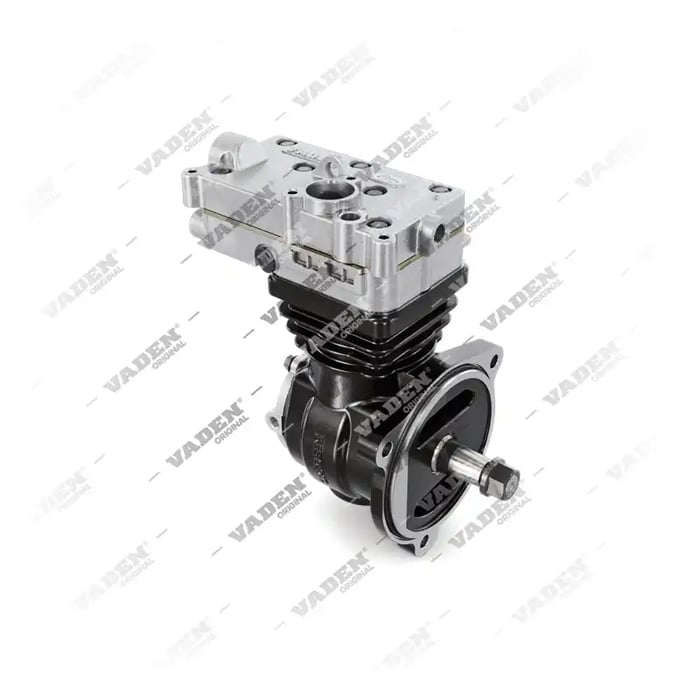
Need the part, not just the answer?
OE-grade air brake compressors and repair kits, manufactured and tested to commercial-vehicle standards.
Shop VADEN partsPublished by VADEN Original. Product links point to the manufacturer’s official catalogue. Specifications are general — always confirm figures against your vehicle’s service manual.