 airbrakecompressor
A "service trailer brake system" warning means the tractor's braking electronics have lost a valid signal from the trailer's ABS or EBS, or have detected a fault the trailer reported back. In plain terms, the truck can no longer confirm the trailer's anti-lock brakes are working, so it flags it. This is an electrical and electronic problem in the overwhelming majority of cases — a bad connector, a damaged cable, low voltage, or a stored trailer ABS fault code — not a sign that the trailer's shoes, drums, or brake chambers have physically failed.
The trailer still has brakes when this light is on. What it usually loses is anti-lock function: most trailer ABS modules default to normal (full) braking without wheel-speed control when they fault. You can still stop, but in a panic stop a trailer wheel can lock and the trailer can push or swing. Treat the warning as urgent, but don't assume you're driving a rig with no trailer brakes at all.
What the warning actually monitors
On modern tractors, the trailer ABS is powered and monitored through the trailer's electrical connection. When you couple and turn the key on, the trailer ABS module runs a self-check and lights its own trailer ABS lamp briefly, then reports its status to the tractor. If that handshake fails — no power to the trailer module, no valid data, or an active fault — the dash throws the "service trailer brake system" message.
Because the message is about communication and electronics, it behaves differently from a pneumatic fault. If the problem were air-side — a weak air compressor, a governor stuck out of range, or the system slowly bleeding down pressure — you'd see a low-air warning and hear the buzzer at roughly 60 psi, not this specific trailer message. Keeping the two straight saves a lot of wasted diagnosis time.
Most common causes, in the order to check them
1. The 7-way connector and its pins
This is the number-one offender. The trailer connector lives in road spray, salt, and grime, and its pins corrode, spread, or bend. A green, crusty, or loose pin — especially the auxiliary/ABS power pin and the ground pin — will drop or interrupt the voltage the trailer module needs to boot and report. Uncouple, inspect both the tractor plug and the trailer socket, and look for corrosion, melted plastic, or a pin that isn't springing back.
2. Damaged or chafed cabling
The power and ABS cables running to the trailer flex constantly and rub on frame rails, the fifth wheel, and the catwalk. Look for chafed insulation, pinched sections, and breaks near the connector strain relief. An intermittent warning that comes and goes with bumps or turns is a classic sign of a cable rubbing through or a connector that's making and breaking contact.
3. Low or lost voltage / bad ground
Trailer ABS modules are voltage-sensitive. A corroded ground, a blown or weak fuse feeding the trailer circuit, or a heavily loaded electrical system dragging voltage down can all set the fault. A quick voltage check at the trailer connector — with the key on — tells you fast whether the trailer is even getting what it needs to run.
4. Wheel-speed sensor faults
Each braked axle end has a wheel-speed sensor and a toothed exciter ring. Sensors get knocked out of position, get coated in debris, or their rings crack or clog. A sensor reading a gap that's too large — or reading nothing — sets an ABS fault, and that fault propagates up to the "service trailer brake system" message.
5. Trailer ABS module (ECU) itself
The module can fault internally, but it's the last thing to suspect, not the first. Water intrusion into the connector, a corroded module plug, or a genuine internal failure will all read as a module fault on a scan tool. Confirm power, ground, and wiring before you condemn an expensive ECU.
Quick diagnostic sequence
| Step | What to check | What it tells you |
|---|---|---|
| 1 | Does the trailer ABS lamp on the trailer light and then go out at key-on? | Confirms the module is powering up and self-testing |
| 2 | Uncouple and inspect the 7-way connector — both plug and socket | Finds corrosion, spread pins, moisture (most common cause) |
| 3 | Measure voltage at the trailer connector, key on | Verifies the trailer is getting power and a good ground |
| 4 | Inspect ABS and power cabling along the frame and fifth wheel | Reveals chafing, pinching, and intermittent breaks |
| 5 | Scan the trailer ABS for active and stored fault codes | Points to a specific sensor, circuit, or module fault |
| 6 | Try a known-good trailer with the same tractor | Isolates whether the fault is tractor-side or trailer-side |
That last step is the fastest way to split the problem. If the warning follows the trailer, the fault is in the trailer's wiring, sensors, or module. If it stays with the tractor regardless of trailer, look at the tractor's trailer-power circuit, fuse, and connector.
Is it safe to drive?
Use judgment. If the warning appears and the trailer still brakes normally — you can feel it working on a low-speed test stop — you generally have braking but likely no trailer anti-lock. Drive gently, increase following distance, and get it diagnosed promptly. If the trailer feels like it isn't contributing any braking at all, park it and fix it before continuing. And remember: an active ABS fault is a citation-level defect at a roadside inspection, so an on-and-off warning shouldn't be ignored just because it clears.
What it is not
This message is not a low-air alarm, not a parking/spring-brake fault, and not a "your brakes are worn out" indicator. Those conditions announce themselves differently — a buzzer and gauge for air pressure, a dash park-brake light for the spring brakes. If you're chasing a genuine air-supply problem instead, the pneumatic fundamentals in how air brake systems work will point you in the right direction. The trailer brake warning stays firmly in the electrical and electronic lane.
Bottom line: most of these come down to a connector or a cable. Clean and inspect the electrical connection first, confirm the trailer has power and ground, then scan for codes — condemn the module only after everything upstream checks out.
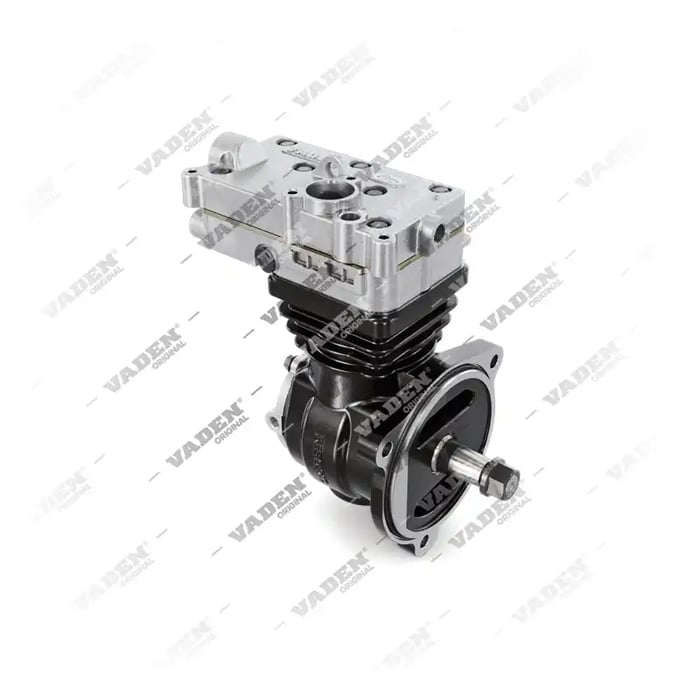
Need the part, not just the answer?
OE-grade air brake compressors and repair kits, manufactured and tested to commercial-vehicle standards.
Shop VADEN partsPublished by VADEN Original. Product links point to the manufacturer’s official catalogue. Specifications are general — always confirm figures against your vehicle’s service manual.