 airbrakecompressor
An air brake chamber turns reservoir pressure into a mechanical push on the slack adjuster. The force it produces is simply effective area × applied pressure, so a Type 30 chamber (about 30 in²) delivers roughly 3,000 lbf at 100 psi and about 3,600 lbf at 120 psi. Use the calculator to size any type at any pressure, or the table below for the standard values and the legal readjustment limits.
Output force calculator
Output force: 3,000 lbf (13,345 N)
Force = effective area × pressure. Values are nominal references; a real chamber's rated output also depends on stroke position and spring state.
Brake chamber reference table (Type 9 to Type 36)
The "type" number is the chamber's nominal effective area in square inches, which is why a Type 24 pushes about a third harder than a Type 16 at the same pressure. Readjustment (out-of-service) limits are the clamp-type values published by the FMCSA.
| Chamber | Effective area (in²) | Force @ 100 psi | Force @ 120 psi | Readjustment limit |
|---|---|---|---|---|
| Type 9 | 9.0 | 900 lbf (4,003 N) | 1,080 lbf (4,804 N) | 1-3/8" (35 mm) |
| Type 12 | 12.0 | 1,200 lbf (5,338 N) | 1,440 lbf (6,405 N) | 1-3/8" (35 mm) |
| Type 16 | 16.0 | 1,600 lbf (7,117 N) | 1,920 lbf (8,541 N) | 1-3/4" (44 mm) |
| Type 20 | 20.0 | 2,000 lbf (8,896 N) | 2,400 lbf (10,676 N) | 1-3/4" (44 mm) |
| Type 24 | 24.0 | 2,400 lbf (10,676 N) | 2,880 lbf (12,811 N) | 1-3/4" (44 mm) · long-stroke 2" (51 mm) |
| Type 30 | 30.0 | 3,000 lbf (13,345 N) | 3,600 lbf (16,014 N) | 2" (51 mm) · long-stroke 2-1/2" (64 mm) |
| Type 36 | 36.0 | 3,600 lbf (16,014 N) | 4,320 lbf (19,216 N) | 2-1/4" (57 mm) |
Readjustment limits after 49 CFR 393.47; system design and timing requirements after FMVSS 121 (49 CFR 571.121). Figures are general references for common clamp-type chambers — the vehicle manufacturer's current service data and the exact chamber marking are authoritative.
Force is the same, stroke is not: matching chambers
Two chambers of the same type are interchangeable on force, but not always on stroke. A standard Type 30 and a long-stroke Type 30 both make about 3,000 lbf at 100 psi, yet the long-stroke version travels further before the diaphragm bottoms out — which is why its readjustment limit is 2-1/2" instead of 2". Mixing a standard and a long-stroke chamber across an axle is a common and dangerous error, because the two respond differently to the same pedal.
Applied stroke that exceeds the readjustment limit means the brake is out of adjustment: the pushrod travels too far, the mechanical advantage at the slack adjuster drops, and braking force falls off exactly when you need it. That is why the 49 CFR 393.47 limits are an out-of-service item at a roadside inspection.
Sizing a replacement
Match three things, in order: the type (effective area, stamped on the clamp band or the non-pressure housing), the stroke class (standard vs long-stroke), and the mounting and pushrod (thread, length, clevis). Getting the type right sets the force; getting the stroke class right keeps the brake in adjustment. For the background on identifying and choosing a chamber, see the brake chamber sizes guide, the standard vs long-stroke comparison, and the brake adjustment limits chart.
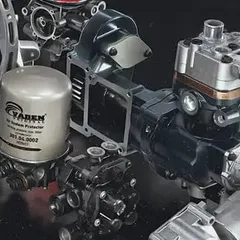
Need the part, not just the answer?
OE-grade air brake compressors and repair kits, manufactured and tested to commercial-vehicle standards.
Shop VADEN partsPublished by VADEN Original. Product links point to the manufacturer’s official catalogue. Specifications are general — always confirm figures against your vehicle’s service manual.